


This article is going to talk about the Best Crypto Transaction Simulation Tools for developers, traders and Web3 teams. These tools are useful to test the blockchain transactions before broadcasting, to analyze the result of execution, to find errors, to calculate gas costs and to review changes in assets or state. We’ll review their key features, supported networks, simulation capabilities, pricing, pros as well as use cases.
What Are Crypto Transaction Simulation Tool?
Crypto Transaction Simulators are developer-focused platforms for testing blockchain transactions before broadcasting them onto a live network. They allow to preview if a transaction is likely to be successful, to estimate gas usage, to check for errors in execution and to see the expected changes to assets and state.
Depending on the tool, developers may also inspect execution traces, internal calls, contract interactions and blockchain forks. Such simulations allow developers to safely test swaps, token transfers, smart-contract calls and DeFi operations without risking real funds and/or permanently changing live blockchain state.
Key Points
| Crypto Transaction Simulation Tool | Best For | Simulation / Testing Strength | Key Capability |
|---|---|---|---|
| Tenderly | Advanced transaction simulation | Very High | Transaction simulation, traces, state changes, bundles, historical replays and forked environments |
| Foundry | Solidity developers | Very High | Local EVM testing, Anvil forking, cheatcodes, traces, fuzzing and scripted execution |
| Anvil | Local blockchain simulation | Very High | Fast local EVM node, mainnet forking, impersonation and controlled blockchain state |
| Hardhat | Smart-contract development | High | Local network, mainnet forking, contract testing and debugging |
| Alchemy Simulation APIs | API-based transaction simulation | High | Programmatic transaction execution and simulation for supported networks |
| Blockscout | Open-source blockchain exploration | Medium–High | Contract interaction, transaction inspection and simulation-related developer tooling |
| Remix IDE | Beginners and Solidity testing | High | In-browser contract execution, debugging and development testing |
| eth-tester | Python-based Ethereum testing | High | In-memory Ethereum backend for fast automated contract tests |
| Ape Framework | Python-based Web3 development | High | Smart-contract testing, local development and network interaction |
| Brownie | Python smart-contract testing | High | Contract testing, local development and transaction debugging |
1. Tenderly
Tenderly is one of the best options for developers who require detailed transaction simulation and debugging. Its simulator outputs execution traces, asset changes, state changes, gas info, revert reasons and multi-step simulation bundles.
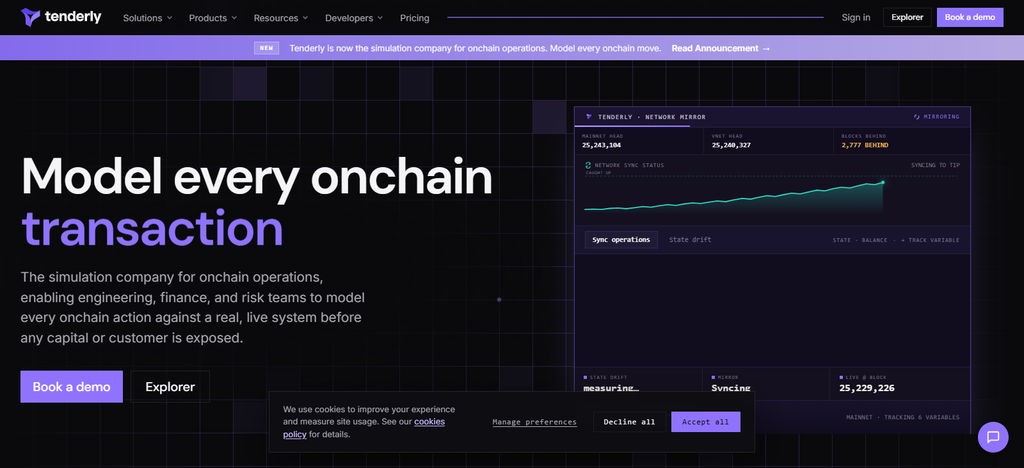
Forking and production-synced virtual environments let developers reproduce scenarios against realistic blockchain state including balances, contracts, liquidity, and oracle data. Tenderly offers 100+ networks, perfect for multichain development and DeFi workflows. Pricing differs based on the Tenderly plan selected and usage requirements; premium features are available at a price.
Tenderly
| Category | Details |
|---|---|
| Core Features | Transaction simulation, simulation bundles, debugging, gas analysis, historical replay, virtual environments, cross-chain simulation and production-state testing |
| Execution Traces | Detailed decoded traces, internal calls, emitted events, stack traces and gas usage breakdowns |
| Asset Changes | Shows token transfers, balance changes and other asset movements resulting from a simulation |
| State Changes | Displays contract and balance state changes and allows developers to inspect expected end-state differences |
| Forking | Supports production-synced forks and virtual environments with configurable state |
| Chain Support | Supports 100+ networks according to Tenderly |
| Pricing | Paid plans and usage-based limits vary by Tenderly offering; enterprise capabilities are available |
| Pros | Excellent debugging, deep simulation visibility, realistic forked environments, multi-step bundles and strong DeFi support |
| Cons | Advanced functionality can be more than beginners need; full enterprise capabilities may require a paid plan |
2. Foundry
Foundry is a developer focused toolkit for Ethereum and EVM smart-contract development, testing, debugging and transaction execution. Its testing environment can evaluate execution traces, calls, logs, gas usage and contract behavior.
Its testing capabilities allow developers to assert expected state and balance changes. The Foundry Anvil component offers powerful local blockchain forking to replicate mainnet conditions and manipulate test environments.
It is focused on EVM compatible development, not providing a hosted multichain simulator. Foundry is open source, so the core toolkit does not require a traditional hosted simulation subscription or a fee for usage of a simulator.
Foundry
| Category | Details |
|---|---|
| Core Features | Solidity development, Forge testing, fuzzing, gas optimization, debugging and automated smart-contract testing |
| Execution Traces | Provides detailed execution information and traces for contract calls and test transactions |
| Asset Changes | Developers can inspect and assert balance and token-related changes through tests and execution results |
| State Changes | Supports controlled state manipulation and assertions for contract storage and blockchain state |
| Forking | Supports forked EVM environments through Anvil for realistic network-state testing |
| Chain Support | Primarily designed for Ethereum and EVM-compatible networks |
| Pricing | Open-source development toolkit; local usage does not require a hosted simulator subscription |
| Pros | Fast, powerful, excellent for Solidity developers, fuzzing and automated testing |
| Cons | Command-line focused and less beginner-friendly than browser-based tools |
3. Anvil
Anvil is Foundry’s local Ethereum development node, useful for forking, testing transactions, and simulating blockchains in a controlled environment. Developers are able to fork a live EVM network and run transactions locally, observe execution behavior, manipulate accounts and test state changes without actually broadcasting transactions to mainnet.
Its local environment is convenient for checking asset movements, contract calls, balances, gas behavior and execution traces when developing. Anvil is focused more on EVM-compatible networks and local testing than on a hosted dashboard. As part of the open-source Foundry ecosystem, developers are able to run it locally without paying a simulator subscription.
Anvil
| Category | Details |
|---|---|
| Core Features | Local EVM node, blockchain simulation, account management, testing and development |
| Execution Traces | Can be used with Foundry tooling to inspect transaction execution and contract calls |
| Asset Changes | Developers can test ETH, token balances and contract interactions within the local environment |
| State Changes | Provides a controllable local blockchain state for testing contract and account changes |
| Forking | One of its major strengths; developers can fork supported EVM network state for local testing |
| Chain Support | EVM-focused and commonly used with Ethereum-compatible network forks |
| Pricing | Open-source and locally runnable without a hosted simulator subscription |
| Pros | Fast local execution, powerful state control, excellent for fork-based testing |
| Cons | Primarily a developer infrastructure tool rather than a polished simulation dashboard |
4. Hardhat
Hardhat is a popular Ethereum development environment for compiling, testing, debugging, and running smart contract software. The local network can be used to simulate transactions while network forking allows developers to work with state from another blockchain network.
Hardhat allows developers to inspect transaction execution, contract calls, events, gas behavior and the state changes that result from it in the development and debugging workflow. Hardhat supports EVM-based networks and enables developers to configure simulated hardfork behavior and forked-network parameters.
The core framework is open-source, so developers have the ability to run local simulations without a hosted transaction-simulation subscription, but there may be infrastructure costs when working with external RPC providers.
Hardhat
| Category | Details |
|---|---|
| Core Features | Smart-contract development, compilation, testing, debugging, local network and deployment workflows |
| Execution Traces | Provides debugging and transaction execution information through its development ecosystem |
| Asset Changes | Developers can test account balances, token interactions and transaction outcomes |
| State Changes | Local testing environments allow developers to inspect and manipulate contract state |
| Forking | Supports network forking for testing against existing blockchain state |
| Chain Support | Primarily supports Ethereum and EVM-compatible development workflows |
| Pricing | Open-source framework; local development does not require a simulation subscription |
| Pros | Mature ecosystem, flexible configuration, strong testing workflow and broad developer adoption |
| Cons | Requires technical setup and is less focused on visual transaction simulation than dedicated platforms |
5. Alchemy Simulation APIs
Alchemy Simulation APIs are designed to simulate transactions before they are broadcast and can return asset changes, decoded execution traces, logs, internal calls and bundle simulation results. developers could use them to programmatically understand transaction outcomes via API requests, instead of having to manually run a local blockchain.
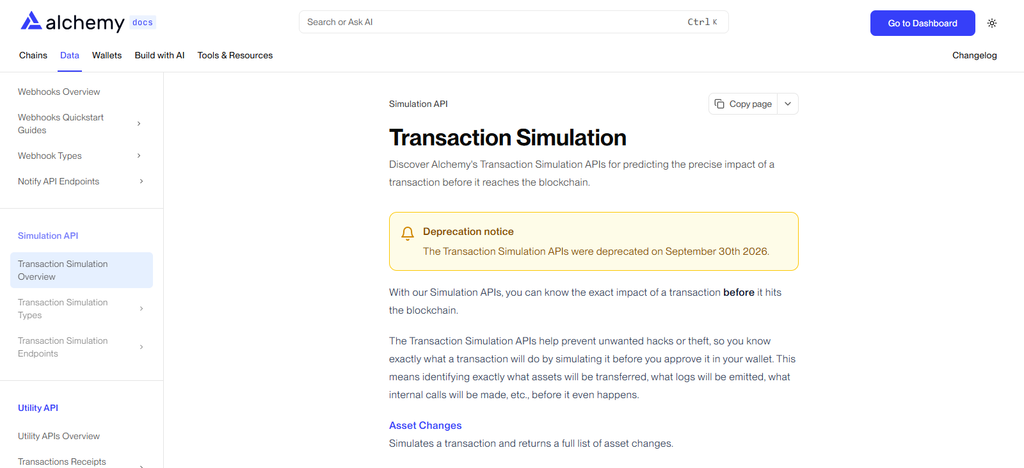
This tool, however, comes with one key 2026 qualification: Alchemy says that its Transaction Simulation APIs were deprecated on September 30, 2026. Therefore, it should not be presented as a primary simulation product available in a 2026 ranking. The rest of Alchemy’s infrastructure is still alive and well, the current PAYG pricing is based on Compute Units.
Alchemy Simulation APIs
| Category | Details |
|---|---|
| Core Features | Transaction simulation, asset-change simulation, execution simulation and sequential bundle simulation |
| Execution Traces | Returned decoded execution traces, internal calls and decoded logs |
| Asset Changes | Could return native assets, ERC-20, ERC-721, ERC-1155 and other supported asset changes |
| State Changes | Simulation results reflected transaction effects based on blockchain state at the simulation point |
| Forking | Not primarily a local blockchain-forking tool |
| Chain Support | Supported networks included Ethereum, Polygon, Arbitrum, Optimism and testnets |
| Pricing | Historical API usage was measured through Alchemy Compute Units; bundle simulation had additional CU cost |
| Pros | Strong API-based simulation, decoded traces, asset changes and bundle simulation |
| Cons | Deprecated September 30, 2026, so it should not be presented as a current primary option |
| 2026 Status | Deprecated |
6. Blockscout
Blockscout is an open-source blockchain explorer and developer infrastructure platform, not a dedicated transaction-simulation service like Tenderly. Its greatest value is transaction inspection, contract interaction, verified-source exploration, logs, internal transactions and visibility into blockchain state.
Developers are able to use Blockscout with local or external simulation environments to explore execution behavior, contract calls, events, balances and transaction results. It’s not the forking that makes it different — Blockscout is an explorer and indexing platform fundamentally.
Organizations can deploy their own instances of Blockscout because of its open-sourced nature, but the availability of hosted infrastructure and costs are dependent on the specific Blockscout deployment and service arrangement.
Blockscout
| Category | Details |
|---|---|
| Core Features | Open-source blockchain explorer, contract verification, transaction inspection, token tracking and developer-oriented blockchain data |
| Execution Traces | Provides transaction and internal-call visibility depending on the indexed chain and deployment |
| Asset Changes | Helps inspect token transfers, balances and transaction-related asset movements |
| State Changes | Provides blockchain transaction and contract information, although it is not primarily a state-simulation engine |
| Forking | Not its core feature; developers generally use dedicated local/forking infrastructure for this purpose |
| Chain Support | Used across many EVM-compatible networks and can be deployed for individual chains |
| Pricing | Open-source software; hosted infrastructure or managed services may have separate costs |
| Pros | Open-source, transparent, useful transaction explorer and strong contract inspection capabilities |
| Cons | Not a dedicated transaction simulator; advanced simulation requires complementary tools |
7. Remix IDE.
Remix IDE is a browser-based development environment, ideal for Solidity developers who need to compile, deploy, test and interact with contracts without setting up a full local toolchain. Its execution environment lets developers send test transactions, inspect calls, examine returned values and observe contract behavior before moving to a production network.
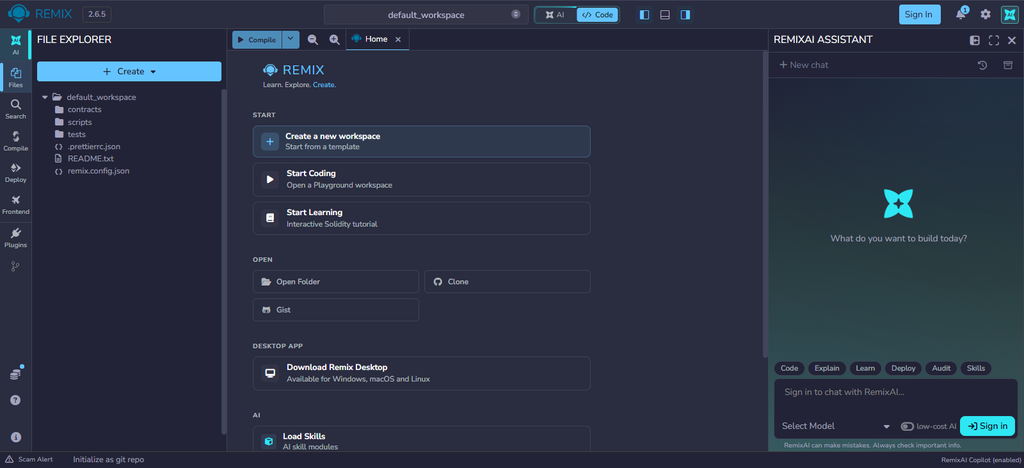
When testing, developers are able to view transaction results, events, gas used, balances and contract state. Remix itself is not a production-grade transaction simulator or mainnet-forking platform like Tenderly. The biggest benefit is its accessibility, and the basic browser-based IDE is free of a traditional simulator subscription.
Remix IDE
| Category | Details |
|---|---|
| Core Features | Browser-based Solidity IDE, compiler, deployment tools, contract interaction and testing |
| Execution Traces | Provides transaction execution information and debugging capabilities through its development environment |
| Asset Changes | Developers can inspect balances, transaction results and contract interactions during testing |
| State Changes | Useful for testing contract state transitions in supported execution environments |
| Forking | Not its primary strength compared with dedicated fork-based tools such as Anvil |
| Chain Support | Can interact with Ethereum and compatible networks through configured environments/providers |
| Pricing | Core browser-based IDE is available without a traditional paid simulator subscription |
| Pros | Beginner-friendly, browser-based, easy Solidity testing and quick experimentation |
| Cons | Less suitable for advanced production-scale simulation and complex fork-based workflows |
8. eth-tester
eth-tester is a Python library to test Ethereum applications against a controlled testing environment. It allows developers to run transactions against a test blockchain environment, view transaction results, work with accounts and balances, and verify contract state changes. Good for automated python-based smart-contract tests, not so good for visually inspecting complex transaction simulations in a dashboard.
Testing execution behavior, changes in assets/balances, state transitions and contract calls programmatically It’s not really intended to fork live mainnet state so developers that need production state forks may need further tooling. Its open-source Python package is available without a subscription to a hosted simulation.
eth-tester
| Category | Details |
|---|---|
| Core Features | Python-based Ethereum testing, transaction execution, account management and automated contract testing |
| Execution Traces | Execution results can be inspected programmatically through the configured backend |
| Asset Changes | Developers can test ETH balances and contract-related asset movements in controlled environments |
| State Changes | Useful for verifying contract storage, balances and transaction state transitions |
| Forking | Not primarily designed as a production-state mainnet-forking platform |
| Chain Support | Focused on Ethereum/EVM testing through supported backends |
| Pricing | Open-source Python package with no hosted simulator subscription requirement |
| Pros | Lightweight, programmable and useful for Python-based automated testing |
| Cons | Less visual, fewer production-style simulation features and requires Python development knowledge |
9. Ape Framework
Ape Framework is a Python-based smart-contract development and testing framework for creating, testing, and interacting with Ethereum and other supported blockchain ecosystems. Developers are able to run contract transactions in a test environment, inspect the results of execution, test state and balance changes and bring testing into Python workflows.
Its plugin architecture allows developers to tailor the framework to a range of networks and development environments. The platform itself does not define forking and advanced simulation features, but the network provider and plugins you configure do.
Since Ape is open source, the framework itself does not require a standard hosted simulator subscription, although external RPC providers or infrastructure may have their own costs.
Ape Framework
| Category | Details |
|---|---|
| Core Features | Python-based smart-contract development, testing, deployment, plugins and network interaction |
| Execution Traces | Provides transaction and testing information through its development and plugin ecosystem |
| Asset Changes | Developers can test balances, transfers and contract interactions programmatically |
| State Changes | Supports testing contract behavior and state transitions within configured environments |
| Forking | Forking capabilities depend on the configured provider and development setup |
| Chain Support | Designed for EVM-compatible smart-contract development with network/provider plugins |
| Pricing | Open-source framework; external providers may introduce separate infrastructure costs |
| Pros | Python-first workflow, extensible plugins, testing and deployment support |
| Cons | Requires development knowledge and is less focused on visual transaction simulation |
10.Brownie
Brownie is a Python-based development and testing framework for Ethereum that provides tools for compiling contracts, running automated tests, interacting with networks, and inspecting transaction execution state. Its testing environment allows developers to test contract calls, transaction results, gas usage, account balances, events and state changes before deploying production code.
Brownie is more about smart-contract development and automated testing, not a dedicated hosted simulation dashboard. Network support is for Ethereum and EVM-compatible workflows created via providers, while advanced mainnet forking is dependent on the development setup. Brownie is open-source so there is no hosted simulator subscription fee for its core framework.
Brownie
| Category | Details |
|---|---|
| Core Features | Python-based smart-contract development, testing, deployment and transaction interaction |
| Execution Traces | Provides transaction information and debugging support within its development workflow |
| Asset Changes | Developers can test account balances, token transfers and contract interactions |
| State Changes | Supports testing contract state and transaction outcomes in development environments |
| Forking | Can work with configured network environments, while advanced fork workflows depend on the provider/setup |
| Chain Support | Primarily focused on Ethereum and EVM-compatible networks |
| Pricing | Open-source framework with no standard hosted simulation subscription |
| Pros | Python-based, integrates with pytest, flexible testing and suitable for automated smart-contract tests |
| Cons | More development-oriented than dashboard-based simulators; newer projects may prefer other actively developed frameworks |
Crypto Transaction Simulation Tools Comparison
| Tool | Best For | Execution Trace | Asset Changes | State Changes | Forking | Chain Support | Pricing |
|---|---|---|---|---|---|---|---|
| Tenderly | Advanced simulation & debugging | Excellent | Excellent | Excellent | Yes | 100+ networks | Paid plans / usage limits |
| Foundry | Solidity development & testing | Excellent | Via testing | Excellent | Yes, through Anvil | EVM networks | Free & open-source |
| Anvil | Local blockchain simulation | Excellent with Foundry | Yes | Excellent | Excellent | EVM networks | Free & open-source |
| Hardhat | Smart-contract development | Very Good | Via testing | Very Good | Yes | EVM networks | Free & open-source |
| Alchemy Simulation APIs | API-based simulation | Excellent | Excellent | Good | Limited | Supported Alchemy networks | Deprecated Sept. 30, 2026 |
| Blockscout | Blockchain inspection | Good | Good | Limited for simulation | Not a core feature | Many EVM networks | Open-source / hosting-dependent |
| Remix IDE | Beginner Solidity testing | Good | Good | Good | Limited compared with dedicated fork tools | Ethereum/EVM networks | Free |
| eth-tester | Python automated testing | Good | Good | Excellent for tests | Not its main focus | Ethereum/EVM testing | Free & open-source |
| Ape Framework | Python Web3 development | Good | Good | Good | Provider-dependent | EVM-compatible networks | Free & open-source |
| Brownie | Python smart-contract testing | Good | Good | Good | Provider/setup-dependent | Ethereum/EVM networks | Free & open-source |
Conclusion
Crypto transaction simulation tools have become a must-have for developers who want to test blockchain transactions before they are on-chain. Tools like Tenderly, Foundry, Anvil, Hardhat, Remix IDE and others offer various methods of execution testing, asset and state-change analysis, transaction debugging and network forking.
The right choice depends on your development workflow, the chains you support, the depth of your simulations, your API needs, your technical expertise and your budget. If you’re looking to do advanced transaction analysis, a dedicated simulator is your best bet. But if you’re a developer building and testing intelligent contracts, local testing frameworks are better.
FAQ
What is a crypto transaction simulation tool?
A crypto transaction simulation tool allows developers to execute a blockchain transaction in a simulated environment before broadcasting it to the actual network. It can help identify failures, estimate gas usage, inspect contract calls, and understand expected asset or state changes.
Why should developers simulate crypto transactions?
Simulation helps developers detect transaction errors before spending real gas or moving real assets. It can also make it easier to understand contract behavior, identify revert conditions, test different inputs, and validate complex transactions before deployment.
Which is the best crypto transaction simulation tool in 2026?
The best tool depends on the developer’s requirements. Tenderly is a strong option for detailed transaction simulation and debugging, while Foundry, Anvil, and Hardhat are well suited to local development, testing, and blockchain forking.
Can transaction simulators show asset changes?
Yes. Some advanced simulation tools can show expected changes to tokens, native cryptocurrency balances, approvals, and other assets resulting from a simulated transaction.