

I will talk about AI cryptocurrency wallets in this article. These wallets integrate artificial intelligence and blockchain technology. AI cryptowallets can process transactions automatically, recover lost funds, and identify fraud.
These wallets go beyond the functions of a conventional cryptocurrency wallet. AI cryptowallets can transact on a user’s behalf with other wallets, DeFi smart contracts, and other similar interfaces. AI crypto wallets will transform digital finance. By 2026, digital finance will be faster and safer with AI cryptowallets.
What Are AI Crypto Wallets?
The AI crypto wallet of 2026 is an advanced cryptocurrency wallet that uses blockchain and artificial intelligence. Traditional crypto wallets only store your private keys. AI crypto wallets make financial transactions automatically and manage your investments. They use machine learning and artificial intelligence to detect financial fraud and minimize the cost of transactions.
AI crypto wallets are designed for the emerging economy where machines transact with one another. AI crypto wallets are compatible with multiple blockchains. They use data and transaction patterns to make educated financial decisions. AI crypto wallets improve the financial experience by using automated financial transactions.
What AI Can Automate for Crypto Users
AI allows crypto users to automate several financial tasks. AI can instantly make trades, based on market conditions. AI can also optimize portfolio holdings by assessing which chains to utilize, based on gas costs and transaction conditions.
AI can also help assess risk by identifying probable fraud. AI can also assist in automating other tasks in the DeFi sector, such as by helping users identify the most profitable opportunities.
By 2026, it is likely that automation in the financial sector will continue to advance, allowing users of the cryptocurrency sector to engage in highly individualized, flexible, secure, and automated financial transactions.
How AI Crypto Wallets Work
Private key storage: These wallets store private keys, usually in hardware Wallets, software Wallets, or both.
AI decision making: There are models of Artificial Intelligence that evaluate a variety of data to determine the optimal time to execute transactions.
Transactions and contract interactions: The AI crypto wallets facilitate transactions, including contracts on the blockchain.
Fraud and risk: There are models that analyze data to determine the best and/or most efficient way to conduct a transaction.
Multi-block chain: AI crypto wallets are designed to work with all blockchains.
Improving results: The models used by the wallets are designed to gain a deeper understanding of transactional data.
Regulations: Some wallets can be configured to adhere to know your customer (KYC) and/or anti-money laundering (AML) requirements.
How to Choose an AI Crypto Wallet in 2026

Security: The wallet must utilize AI and other security features such as encryption and fraud prevention.
Controls: The wallet must allow the user to set rules to control spending and require approval for transactions.
Blockchain: The wallet must support multiple blockchains and stablecoins.
DeFi: The wallet must support DeFi features.
Learning: The wallet must learn and implement new strategies.
Compliance: Wallets must support KYC and AML features for institutional users.
User Experience: The wallet must support features such as yield farming.
Reliability: The wallet must be supported and audited by the developer.
Key Features of AI Crypto Wallets
Programmable Autonomy
Wallets are designed to be organized around agent-based architecture to enable automated execution of financial transactions.
Real-Time Crypto Economics
AI is used to analyze transactions in real time to detect fraud and to optimize transactions by analyzing market conditions.
Multi-Bridge Crypto Economy
Support for Ethereum and other blockchain ecosystems, and stablecoins.
Smart Contracts
Wallets are designed to interact with other decentralized finance applications.
Crypto Economics
The use of machine learning to enhance the wallet in providing financial services to customers.
Regulation
Integration of AML and KYC to provide wallet services to both institutional and retail customers.
Fraud Detection
AI is used to evaluate transactions to identify irregular or fraudulent activities.
UX
Design of the wallet to provide control to the customer, and improve transparency.
Who Should Use AI Crypto Wallets?
AI crypto wallets in 2026 offer next generation features in financial services by providing customers with more control over their digital assets. AI integrations allow customers to set rules and conditions and have the peace of mind that their digital financial activities will be executed as planned.
With AI integrations, portfolio rebalancing, and DeFi activities will no longer require manual supervision. As for large financial institutions, AI integrations will allow them to develop strategies and comfortably transact in various blockchains.
As for individual technology entrepreneurs, AI integrations will allow them to develop machine-to-machine microtransactions to access digital services and facilitate commerce. No doubt AI integrations will allow all users of crypto wallets to monitor their digital finance activities in a more effective and efficient way.
Security and Privacy: What Users Should Know

Private Key Protection: These wallets employ secure enclaves and other hardware to safeguard private keys.
Fraud Detection and Prevention: AI is incorporated to detect and prevent fraud by analyzing transaction patterns.
Data Privacy: AI crypto wallets employ zero-knowledge proofs and other privacy-preserving technologies to mask transacting parties.
Control and Restrict Spending: AI crypto wallets empower users to set spending limits, and other controls, to prevent unauthorized spending.
Multi-Layer Protection and Control: In addition to biometric MFA, other controls are in place to prevent unauthorized use.
KYC/AML Integration: AI crypto wallets integrate UXF and other privacy-preserving technologies to protect user data while facilitating user compliance with AML/CFT and KYC requirements.
Encrypted Transactions: All communications between the wallet and the network are encrypted.
Human Overrider: In some instances, especially in transactions involving high amounts, the user is required to authorize the transaction.
AI Crypto Wallets vs Traditional Crypto Wallets
| Traditional Wallets | AI Crypto Wallets |
|---|---|
| Manual approval for every transaction | Automated execution under policy rules |
| Human‑driven decision making | AI algorithm‑driven strategies |
| Limited speed and scalability | Millisecond execution, billions of transactions |
| Simple send/receive functionality | Complex DeFi strategies and smart contract interaction |
| Static functionality | Adaptive learning and optimization |
| Security depends on user practices | AI‑powered fraud detection and risk monitoring |
| No compliance integration | Built‑in KYC/AML frameworks for regulatory alignment |
| Primarily peer‑to‑peer transfers | Supports machine‑to‑machine microtransactions |
Benefits of AI Crypto Wallets
Seamless Transactions: Wallets will be able to facilitate transactions, payments, and rebalances within a portfolio automatically.
Risk Management: AI will be able to detect risks in transactions and block them.
Economical Transactions: Crypto wallets will be able to minimize the cost of transactions by choosing the cheapest option.
DeFi: Wallets will be able to access and use DeFi applications.
Support: Wallets will be able to interact with various blockchain networks.
Strategies: AI will be able to learn and develop strategies to be used in conjunction with the user to achieve a goal.
Comply: Wallets will be able to integrate KYC and AML to facilitate compliance with financial regulations.
Micropayments: AI crypto wallets will be able to facilitate transactions between devices.
Risks and Limitations
Model Bias
AI may not correctly interpret the data and may approve or reject transactions erroneously.
Data Quality
Wallets may be vulnerable to attacks by malicious users due to the use of poorly generated training data by the AI.
Over dependence on AI
A lack of user control may result in greater likelihood of wallet errors.
Regulatory Changes
Flexibility of users and institutions with regard to changes in laws may create problems for the users of the wallets.
Cyber Attacks
Protection of wallets by cryptographic techniques will not necessarily prevent attacks by sophisticated users.
Complexity
Features of the wallet may not be simple enough to be controlled by the average user.
Cost
The use of AI may result in higher charges for wallet use.
Transparency
User may not be able to decipher the reason for a transaction undertaken by the wallet.
Reliance on Internet
Users may not be able to control the funds in the wallet due to disruption of Internet connectivity.
AI Crypto Wallet Use Cases in 2026
In 2026, various use cases mean that AI crypto wallets can be applied by businesses and individuals alike. AI crypto wallets provide the ability to perform sophisticated trading strategies by executing orders to buy and sell based on market conditions and automatically rebalance a user’s portfolio. Users can transact in a fully automated manner across various blockchains.
Businesses can use AI crypto wallets to make microtransactions between machines. For example, machines can make payments to other machines to use an API or cloud service. All users can benefit from improving the security of their funds by integrating a AI crypto wallet.
This includes avoiding gas fees and using the AI to automatically detect fraud. Users can also rely on the wallets to automate interactions with Decentralized Finance applications and earn rewards through the wallets for providing liquidity or other activities.
Future of AI Crypto Wallets
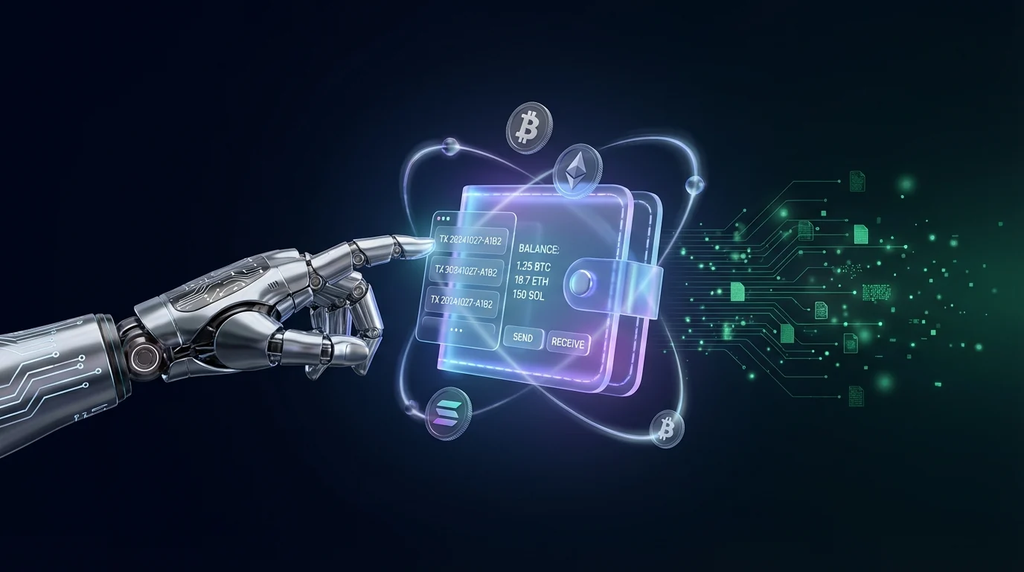
We expect fully autonomous financial agents in AI crypto wallets by 2026. These will provide even greater control over traditional financial assets and digital financial arrangements. Predictive analytical smart contracts will make decisions on when to buy, sell, and trade financial instruments.
Improvements to blockchain technology will implement interoperability to other blockchains, establish trust between blockchains, and provide more efficient payment channels for various commercial interactions. Artificial Intelligence and other technologies will be adapted to comply with financial industry regulations and policies.
Distributed ledger technology and cryptography will provide the foundation for portfolio management and financial services. Wallets will continue to incorporate innovative techniques for protecting customers’ private information. This will include implementing AI to generate recommended financial strategies.
Pros & Cons
| Pros | Cons |
|---|---|
| Automated transactions save time and effort | Over‑automation may reduce user oversight |
| Real‑time fraud detection enhances security | AI model bias can cause false approvals/rejections |
| Gas fee optimization lowers transaction costs | Complexity may overwhelm everyday users |
| Seamless DeFi integration for yield farming & swaps | Regulatory uncertainty creates compliance challenges |
| Multi‑chain support expands usability | Cybersecurity risks remain despite encryption |
| Adaptive learning improves portfolio strategies | Limited transparency in AI decision‑making (“black box”) |
| Built‑in compliance tools aid institutions | Higher costs for advanced AI features |
| Enables machine‑to‑machine microtransactions | Dependency on internet connectivity for operations |
FAQs
What are AI crypto wallets?
AI crypto wallets are intelligent digital wallets that use machine learning to automate transactions, manage portfolios, and enhance security.
How do they differ from traditional wallets?
Traditional wallets only store keys, while AI wallets act as autonomous agents, executing trades, detecting fraud, and interacting with DeFi protocols.
Are AI crypto wallets safe?
Yes, they use advanced encryption, fraud detection, and compliance frameworks, but risks like cyberattacks and model bias remain.
Who should use them?
Investors, institutions, and developers benefit most—whether for automated trading, compliance, or machine‑to‑machine payments.