


In this article, I will review the Best Crypto Gas Abstraction Platforms and how they make blockchain transactions easier by removing the need for users to have native gas tokens. I will evaluate the leading platforms based on their gas payment models, supported networks, sponsorship options, pricing, onboarding for developers, smart accounts, paymaster infrastructure, and suitability for modern Web3 applications.
What Is Crypto Gas Abstraction Platforms?
Crypto gas abstraction platforms are blockchain infrastructure solutions that make it easier for users to pay for transaction fees.
Instead of requiring users to hold a network’s native token like ETH for every transaction, these platforms can let apps sponsor gas or enable users to pay fees in supported tokens. They often leverage account abstraction, smart accounts, paymasters, bundlers and relayers to handle transaction execution and fee settlement.
This allows for a better Web3 experience, especially for consumer apps, wallets, gaming, DeFi, and multichain apps. Developers may also set rules on sponsorship, spending limits, supported tokens and transaction policies to regulate gas costs.
Key Points
| Platform | Key Point |
|---|---|
| Biconomy | Provides gas sponsorship, smart accounts, transaction batching, and ERC-20 gas payment capabilities for Web3 applications. |
| Pimlico | Offers ERC-4337 infrastructure with bundler and paymaster services that enable gasless user experiences. |
| ZeroDev | Delivers modular smart accounts, session keys, and gas abstraction features built on ERC-4337 standards. |
| Particle Network | Provides account abstraction infrastructure, smart wallets, and gasless transaction support for Web3 onboarding. |
| Gelato | Offers Relay and Account Abstraction services that allow developers to sponsor gas fees and automate transactions. |
| Etherspot | Provides account abstraction infrastructure, bundler services, and paymaster solutions for gasless interactions. |
| Alchemy | Supports ERC-4337 account abstraction through bundler and paymaster infrastructure for smart accounts. |
| Safe (Safe Core) | Enables programmable smart accounts with support for gas sponsorship, modular security, and account abstraction integrations. |
| Coinbase Smart Wallet | Uses account abstraction technology to enable passkey-based wallets and streamlined gas management. |
| Rhinestone | Provides modular account abstraction tools and smart account extensions for gas-abstracted Web3 experiences. |
1. Biconomy
Biconomy’s Smart Account, Paymaster and modular execution infrastructure provide gas abstraction, enabling sponsored transactions and ERC-20 gas payments. Its gas model allows developers to sponsor users or users to pay fees with tokens.
Its Nexus smart account supports ERC-4337 and ERC-7579-based modular functionality. Biconomy also introduces gas abstraction to multichain execution with its Modular Execution Environment where gas can be managed across chains.
Developers are able to plug in via Biconomy’s SDK and APIs. Sponsorship and spending policies allow developers to control transaction costs. It has built in infrastructure for DeFi, wallets, gaming and consumer dApps.
Biconomy Features
- Gas Sponsorship: Enables sponsored and gasless transactions via its paymaster infrastructure.
- ERC-20 Gas Payments: Users can pay transaction fees with supported ERC-20 tokens.
- Smart Accounts Modular smart accounts through Nexus with ERC-7579 support.
- Cross Chain Execution: MEE facilitates orchestration and streamlined execution of cross chain transactions.
Developer Tools: Provides AbstractJS/SDK, bundler, paymaster, and smart-account infrastructure to dApp developers.
| Pros | Cons |
|---|---|
| Full-stack gas abstraction with smart accounts, bundler, and paymaster infrastructure. | Full-stack architecture can be more than needed for teams requiring only a bundler or paymaster. |
| Supports sponsored transactions and ERC-20 gas payments. | More advanced cross-chain functionality can add implementation complexity. |
| Strong modular account and ERC-7579 direction through Nexus. | Developers need to understand its broader execution stack for advanced use cases. |
| Cross-chain execution and transaction batching improve UX. | Provider-specific features can increase infrastructure dependency. |
| Useful for gaming, DeFi, and consumer dApps requiring gasless experiences. | Pricing and infrastructure costs should be evaluated according to transaction volume. |
2. Pimlico
Pimlico brings together ERC-4337 bundler and paymaster infrastructure for gas sponsorship and token-based gas payments. It supports a payment model for fully sponsored transactions and gas payments in ERC-20 tokens including stablecoins, allowing users to transact without having to hold native gas tokens.
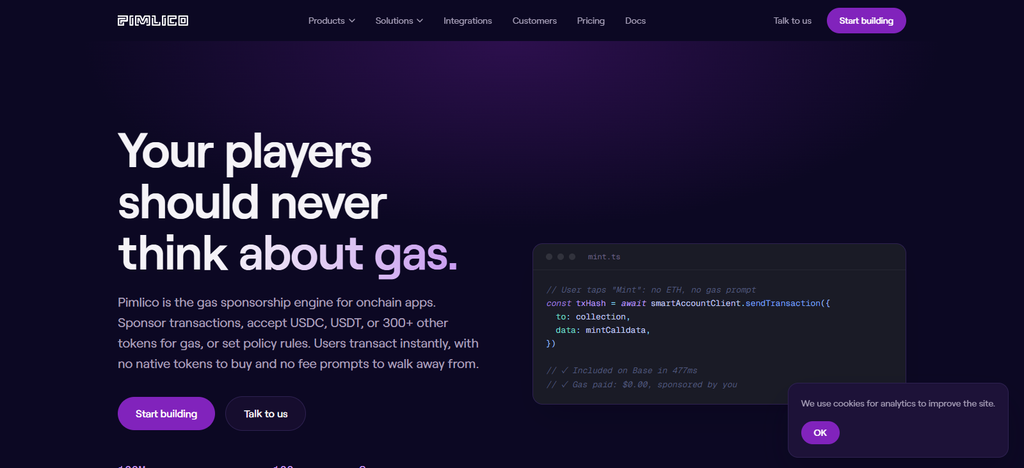
Supported Chains: 100+ chains including Ethereum, Base, Arbitrum, Optimism, Polygon, BNB Chain, Avalanche, Gnosis etc. Developers are able to integrate through its APIs, permissionless.js, bundler and paymaster services.
Sponsorship policies include limits on spending per transaction, per user, and per campaign. Production sponsored gas is charged at actual cost plus 10% surcharge for mainnet, whereas for enterprise the rates are negotiable.
Pimlico Features
- Paymaster Infrastructure: Enables sponsored transactions and gas payments using ERC-20.
- Bundler: Provides its ERC-4337 bundler infrastructure for UserOperation processing, Alto.
Permissionless.js: An account-agnostic SDK for developers building smart-account apps. - Stablecoin Gas: Allows payment of gas in tokens like USDC and USDT when set up.
- Modular Compatible: Compatible with ERC-7579 accounts like Kernel, Safe7579, Nexus and Etherspot accounts.
| Pros | Cons |
|---|---|
| Account-agnostic infrastructure gives developers flexibility in choosing smart accounts. | Developers may need to assemble more components themselves than with an opinionated wallet stack. |
| Provides bundler, verifying paymaster, and ERC-20 paymaster infrastructure. | Requires developers to understand ERC-4337 and paymaster configuration. |
| Permissionless.js simplifies integration with multiple smart-account implementations. | Advanced configurations can require additional development work. |
| Broad EVM chain coverage is useful for multichain applications. | Infrastructure-focused approach may be less suitable for teams wanting a complete consumer wallet solution. |
| Supports sponsored transactions and token-based gas payments. | Total cost depends on gas usage and selected infrastructure configuration. |
3. ZeroDev
ZeroDev provides gas abstraction via its Kernel smart-account infrastructure, paymaster services, and account-abstraction tooling. USDC is supported for gas payments on Ethereum, Polygon, Base, Optimism and Arbitrum, with the ability to pay gas with ERC-20 tokens, and custom tokens supported through self-funded paymasters.
ZeroDev has complete sponsorship controls with project, contract, wallet, and custom policies with restrictions on gas amount, requests, gas price, and transaction amount.
Its developer stack includes Kernel, SDKs, bundler and paymaster RPCs. External infrastructure providers can also be connected by developers. Paid plans include gas sponsorship and infrastructure for production.
Zero Dev Features
- Kernel Smart Accounts: Kernel, a modular architecture for ERC-7579 smart-accounts.
- Gas Sponsorship: Developers are able to sponsor transaction fees with configurable gas policies.
- Session Keys: Delegated and limited permissions for gaming, automation, and agent-based applications.
- Gas Policies: Developers could implement spending limits, function restrictions and sponsorship rules.
- Developer SDK: Tools for creating and managing Kernel accounts and account-abstraction transactions.
| Pros | Cons |
|---|---|
| Kernel provides a highly modular smart-account architecture. | Kernel’s modular design can create a steeper learning curve for beginners. |
| Strong session-key support for gaming and automated applications. | Advanced permissions require careful configuration and testing. |
| Gas Policies provide granular sponsorship and spending controls. | Teams may need additional infrastructure knowledge for complex deployments. |
| Supports ERC-7579 modular account functionality. | Its strongest capabilities are most valuable to applications with sophisticated account requirements. |
| Well suited for games, agents, automation, and programmable wallets. | Choosing and managing modules can add architectural complexity. |
4. Particle Network
Particle Network solves gas abstraction by using Account Abstraction and Universal Accounts. This combines smart accounts and chain abstraction so users can interact across different networks without having to remember their gas balance for each network.
Its Universal Gas model enables users to pay for transaction costs with different tokens, while settlement is done via Particle’s infrastructure. Particle supports EVM ecosystems and has extended its Universal Accounts architecture with EIP-7702 so existing accounts can take advantage of chain-abstracted functionality without creating new addresses.
Developers are able to integrate through the Universal SDK and Account Abstraction SDK, with gas sponsorship and stablecoin payment options making onboarding easier. Particle says its chain-abstraction solutions are free for developers.
Particles System Features
- Universal Accounts: Chain-abstraction infrastructure that will enable users to have a unified account experience across networks.
- Universal Gas: Allows users to transact across supported chains without needing to manage each chain’s native gas token individually.
- Wallet Abstraction: Combines account creation and blockchain interaction into a seamless, Web2-style onboarding experience.
- Developer SDK: Universal SDK and account-abstraction tooling for application integration.
- Social Login: Connect to smart-account infrastructure with familiar onboarding options like email, phone, and social authentication.
| Pros | Cons |
|---|---|
| Universal Accounts simplify user interaction across multiple blockchain networks. | Chain-abstraction architecture can introduce additional infrastructure dependencies. |
| Universal Gas reduces the need for users to manage individual native gas tokens. | Developers should carefully evaluate supported chains and transaction flows for their use case. |
| Social login and wallet abstraction support Web2-style onboarding. | More advanced cross-chain functionality may require deeper integration work. |
| Useful for consumer applications seeking simplified multichain UX. | Teams wanting only basic gas sponsorship may find the broader stack unnecessary. |
| Provides SDK-based integration for account and wallet abstraction. | Developers should evaluate vendor dependency and long-term portability. |
5. Gelato
Gelato supports both ERC-4337 and EIP-7702 smart-account flows, allowing gas abstraction via its Paymaster and Bundler infrastructure. Developers are able to sponsor transactions, or enable users to pay gas with supported tokens, creating a flexible gas payment model for consumer apps. Gelato claims to support over 100 chains and provides a single gas tank for sponsorship on supported networks.
Controls include global or per-user limits, allowlists, blocklists, and time-bound campaigns. Post-execution billing based on actual gas usage. Developers are able to connect through APIs and SDKs and submit UserOperations directly. Gelato also offers custom fees for applications that want to monetize transaction activity.
Gelato Features
- Bundler: Supplies the bundler infrastructure for ERC-4337 smart-account transactions.
- Gasless Transactions: Applications can pay transaction fees on behalf of users, allowing interaction without users having to hold native gas tokens.
- Paymaster: Offers a managed paymaster infrastructure for sponsored and tokenized gas flows.
- EIP-7702 Support: Supports newer account abstraction flows in addition to ERC-4337.
- Multi Chain Infrastructure: Smart wallet & gas infrastructure for 100+ chains, relay & automation infrastructure.
| Pros | Cons |
|---|---|
| Combines bundler, paymaster, relay, and automation infrastructure. | Broad infrastructure coverage can make the platform more complex than a dedicated gas provider. |
| Supports sponsored and token-based gas payment models. | Costs can vary with gas usage, sponsorship configuration, and infrastructure requirements. |
| Supports ERC-4337 and EIP-7702-based account-abstraction flows. | Developers need to configure sponsorship policies carefully to control spending. |
| Broad multichain coverage benefits applications deployed across multiple networks. | Heavy reliance on managed infrastructure may not suit teams preferring self-hosted components. |
| Useful for gasless UX combined with transaction automation. | Teams using only basic gas sponsorship may not need its full feature set. |
6. Etherspot
The technology that powers Etherspot’s account-abstraction infrastructure is its Modular SDK, Skandha ERC-4337 bundler, TransactionKit and Arka Paymaster. Its gas-payment model supports sponsored and gasless transactions through the paymaster. It has a modular architecture which allows developers to customize the smart-account functionality.
It supports Ethereum, Polygon, Optimism, Arbitrum One, Fuse and Mantle, and has a growing infrastructure that will support more EVM networks. Etherspot pricing starts at a free testnet tier for 1 million credits per month. Mainnet Pay-As-You-Go at $1 per 250,000 credits, with network gas charged separately at cost, with no markup. Enterprise plans are custom priced with custom infrastructure.
Etherspot Features
- Arka Paymaster: Infrastructure for sponsoring transaction gas in account-abstraction applications.
- Modular SDK: Developer tools to develop smart-account/account-abstraction applications.
- ERC-7579 Support: Modular account approach, for interoperability with the growing ERC-7579 ecosystem.
- Cross-Chain Execution: Transaction orchestration and batched UserOperations across supported networks.
| Pros | Cons |
|---|---|
| Provides bundler, paymaster, smart-account, and SDK infrastructure. | Its broader transaction-orchestration stack can require additional configuration. |
| Arka provides paymaster infrastructure for sponsored transactions. | Developers need familiarity with account-abstraction architecture. |
| Supports modular account and ERC-7579-oriented development. | Advanced cross-chain workflows can increase implementation complexity. |
| Strong focus on transaction orchestration and multichain execution. | Smaller teams may prefer a simpler managed gas-sponsorship solution. |
| Useful for developers building customized smart-account infrastructure. | Final infrastructure costs depend on usage and selected services. |
7. Alchemy
Through its Account Kit, Bundler API and Gas Manager, Alchemy offers gas abstraction that enables developers to sponsor users’ transactions and accept ERC-20 gas payments. Its wallet infrastructure supports a broad range of networks such as Ethereum, Base, Arbitrum, Optimism, Polygon, BNB Chain, Avalanche, and many other EVM networks.
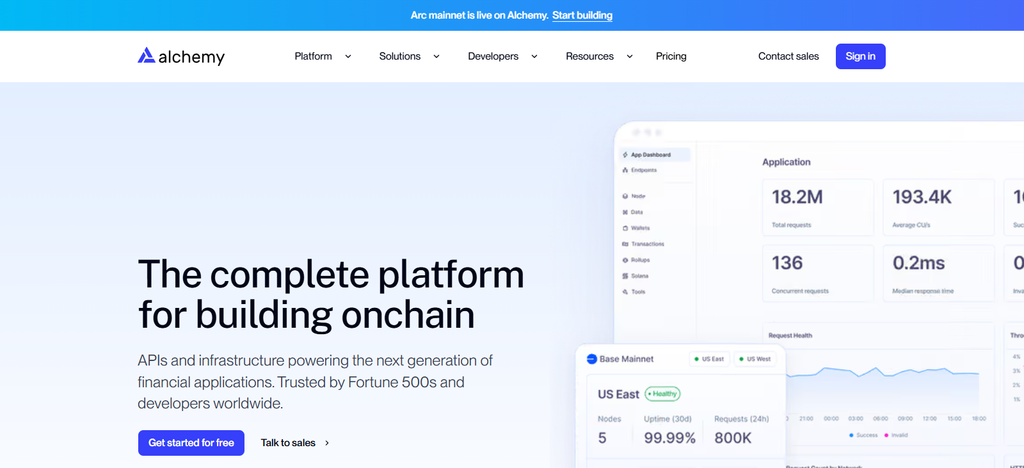
Gas sponsorship can be set up through Gas Manager policies and usage can be tracked via Alchemy’s infrastructure. 30 million Compute Units per month on the free plan. Pay-As-You-Go from $0.525 per million Compute Units. Gas Manager charges an 8% administration fee on PAYG sponsored gas. Enterprise pricing for larger deployments.
Alchemy Features
- Account Kit: holistic smart-wallet SDK for building and managing smart accounts.
- Gas Manager: Enables developers to sponsor user transactions eligible via configurable policies.
- Rundler Bundler: An open-source ERC-4337 bundler written in Rust to process UserOperation.
- Policy Controls: Supports controls such as spending caps, allow-lists, and sponsored-function restrictions.
- Developer Infrastructure: Bundling, paymaster, APIs, RPC infrastructure and smart accounts in a single dev stack.
| Pros | Cons |
|---|---|
| Account Kit combines smart wallets with Alchemy’s broader blockchain infrastructure. | Developers already using another RPC provider may not need the complete Alchemy stack. |
| Gas Manager supports sponsored transactions and configurable spending rules. | Sponsored gas can add service costs on top of underlying blockchain fees. |
| Supports ERC-20 gas payments, including stablecoin-based flows. | Alchemy’s account architecture can create greater provider dependence. |
| Strong SDK, APIs, RPC, bundler, and wallet tooling simplify integration. | Developers seeking maximum account-model neutrality may prefer infrastructure-only providers. |
| Suitable for applications requiring scalable production infrastructure. | Pricing should be assessed carefully for high-volume applications. |
8. Safe (Safe Core)
Safe Core introduces gas abstraction to Safe smart accounts, enabling transaction fees to be paid from the Safe Account balance, rather than requiring separate signing wallets with native gas tokens. Safe’s gas-abstraction rollout currently covers Ethereum, Base, BNB Chain and Arbitrum, with support being added progressively.
Gas assets supported: Native tokens and the following major stablecoins depending on the network: USDC, USDT, DAI, PYUSD and WETH. Developers are able to use Safe Apps or WalletConnect integrations, and Safe’s smart-account infrastructure, while the wallet pays for the gas from the Safe balance. The model is particularly effective for multisig, treasury, DAO and enterprise workflows.
Safe (Safe Core) Features
- Smart Accounts: Safe offers programmable smart accounts for self-custody and organizational asset management.
- Multisig security: Transactions are signed by multiple owners before execution.
- Modular Architecture: Safe accounts can be extended with modules and account-abstraction functionality.
- Gas Abstraction: Well designed infrastructure will facilitate sponsored and alternative gas-payment flows through compatible providers.
Developer Ecosystem: Safe Core offers SDKs, smart-account contracts, APIs, and integrations for wallets, DAOs, treasury systems, and dApps.
| Pros | Cons |
|---|---|
| Strong smart-account infrastructure with a major focus on security and self-custody. | Safe is more focused on account and treasury infrastructure than being a complete managed paymaster provider. |
| Native multisig functionality is valuable for DAOs, organizations, and treasuries. | Gas abstraction may require integration with compatible external infrastructure. |
| Modular architecture allows additional account functionality through modules. | Developers may need more configuration for consumer-focused gasless experiences. |
| Safe Core provides SDKs and developer tooling for integrating Safe accounts. | Multisig-oriented functionality can be unnecessary for simple consumer wallets. |
| Strong fit for institutional, treasury, and organizational applications. | Account configuration can be more complex than simple embedded-wallet solutions. |
9. Coinbase Smart Wallets
Coinbase Smart Wallet uses passkey-based smart accounts to simplify transaction signing, and can also support applications that sponsor network fees. Its current smart-wallet network coverage includes Base, Ethereum, Optimism, Arbitrum, Polygon, and Avalanche C-Chain, with EVM compatibility a core requirement.
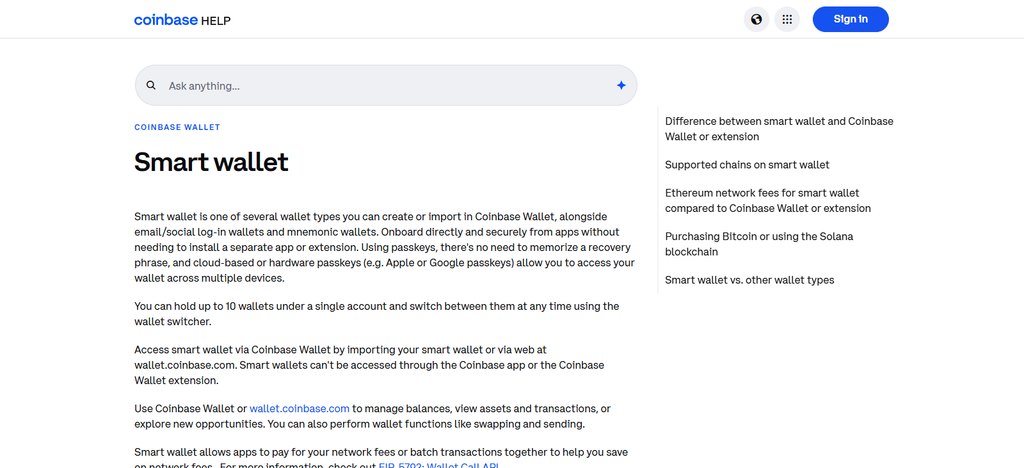
Coinbase also offers CDP Paymaster infrastructure for sponsored transactions, with direct Paymaster support currently for Base and Base Sepolia. Developers are able to integrate through the Base Account SDK, Coinbase Developer Platform, Wagmi, and Viem.
Contract allowlists can be used for sponsorship policies. For the user, the model eliminates the need to pre-fund a wallet with ETH to qualify for sponsored transactions, especially on Base.
Coinbase Smart Wallet Features
- Gas Sponsorship Developers are able to sponsor eligible transactions using Coinbase’s paymaster infrastructure.
Account Abstraction: offers smart-account functionality for consumer-friendly Web3 applications. - Developer Integration: Integration using the Coinbase Developer Platform and associated wallet development tools.
- EVM Compatibility: Smart Wallet is compatible with any EVM compatible network, making it perfect for applications that want to work within the Ethereum ecosystem.
| Pros | Cons |
|---|---|
| Passkey-based authentication provides a simpler alternative to seed-phrase management. | Its strongest ecosystem advantages are closely tied to Coinbase’s infrastructure. |
| Supports sponsored transactions for eligible application flows. | Sponsorship availability and limits can vary by network and configuration. |
| Designed for consumer-friendly smart-wallet onboarding. | Developers wanting highly customizable modular accounts may prefer Kernel or Nexus. |
| Integrates with Coinbase Developer Platform and related developer tools. | Coinbase-specific architecture can reduce portability compared with account-agnostic infrastructure. |
| Strong option for applications targeting mainstream users and Base. | Teams targeting many different ecosystems should verify network-specific capabilities before deployment. |
10. Rhinestone
Rhinestone is focused on building modular smart-account infrastructure, gas abstraction, relaying and self-custodial wallet experiences. Its wallet stack enables applications to sponsor gas and fees or facilitate user payments via supported token balances, while its relaying infrastructure manages multichain execution and token routing.
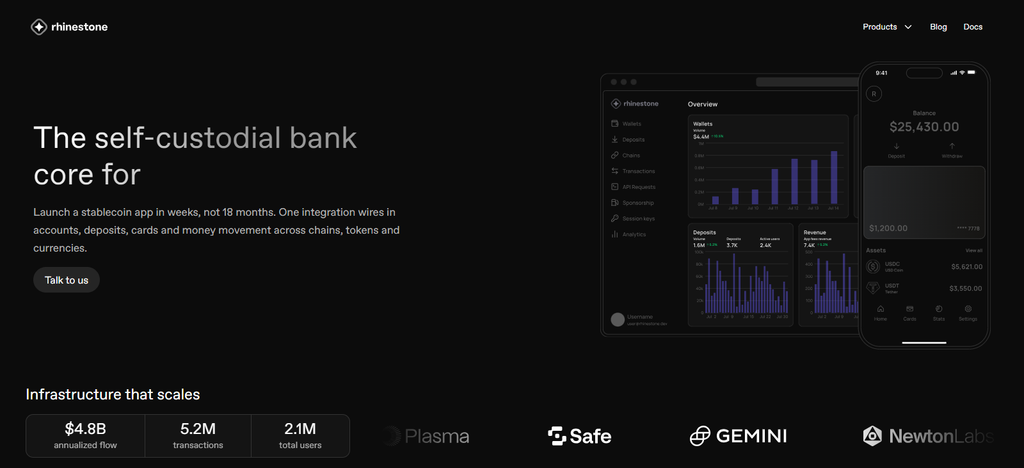
Rhinestone says that it can support 18 EVM networks, plus Solana and Tron, and its architecture is compatible with ERC-7579 and EIP-7702. The Safe7579 Adapter allows developers to use the ModuleSDK with ERC-7579 accounts such as Biconomy Nexus, ZeroDev Kernel, Etherspot Prime, and Safe. Its gas controls include global sponsorship and token-based fee management, making it particularly relevant for fintech, consumer apps, and agent platforms.
Rhinestone Features
- Modular Smart Accounts: Infrastructure for development and extension of smart accounts that are compatible with ERC-7579.
- ModuleKit: Assists developers in building validators, executors, hooks, and other account modules.
Safe Compatibility: The Safe7579 adapter allows ERC-7579 modules to be compatible with Safe accounts. - Gas Abstraction: Supports transaction experiences with relaying and gas-payment infrastructure.
Cross-Chain Infrastructure: Modular execution and orchestration for apps that need flexible account and transaction infrastructure.
| Pros | Cons |
|---|---|
| Strong focus on modular smart-account infrastructure and ERC-7579. | Its modular architecture can be technically demanding for beginners. |
| Module-based design supports customizable wallet functionality. | Developers must carefully select and manage compatible modules. |
| Supports sophisticated permissions and smart-account use cases. | It may be excessive for applications needing only simple gas sponsorship. |
| Safe compatibility expands the range of smart-account deployments. | Cross-chain and advanced execution flows require more architectural planning. |
| Useful for wallets, fintech applications, and programmable transaction systems. | Developers should evaluate module compatibility and infrastructure dependencies before production deployment. |
Conclusion
By eliminating the need for users to handle native gas tokens, crypto gas abstraction platforms are streamlining the user interface of Web3 transactions. Sponsored transactions, token-based gas payments, smart accounts, and multichain execution are available in various forms from Biconomy, Pimlico, ZeroDev, Particle Network, Gelato,
Etherspot, Alchemy, Safe Core, Coinbase Smart Wallet, and Rhinestone. When selecting a platform, developers should consider supported networks, paymaster capabilities, sponsorship controls, pricing, SDKs, security, and integration requirements. Which is the right choice depends on whether the priority is user onboarding, gas sponsorship, stablecoin payments, multichain applications, wallets, DeFi, gaming or enterprise-grade Web3 infrastructure.
FAQ
What is crypto gas abstraction?
Crypto gas abstraction is a blockchain technology approach that hides or simplifies the requirement for users to hold a network’s native gas token. It can enable sponsored transactions or allow users to pay gas with supported tokens such as stablecoins.
How does gas abstraction work?
Gas abstraction typically uses smart accounts, paymasters, bundlers, and relayers to handle transaction execution and fees. A dApp can sponsor the gas, or the infrastructure can convert or accept another supported token for covering the network fee.
Are gasless transactions completely free?
Not necessarily. A transaction still generates blockchain network costs. In a sponsored model, the dApp, developer, or paymaster covers those costs instead of the user. Some platforms may also charge infrastructure or service fees.
Which platforms support gas sponsorship?
Platforms such as Biconomy, Pimlico, ZeroDev, Gelato, Etherspot, Alchemy, Particle Network, and Coinbase’s smart-account infrastructure provide gas sponsorship or related gas-abstraction capabilities, depending on the network and implementation.