


In this article I will explore the best cross-chain messaging protocols for 2026 and compare the leading solutions on security models, verification methods, supported networks, message delivery, fees, developer experience and interoperability capabilities. Whether you’re building omnichain applications, cross-chain DeFi, token infrastructure or smart-contract communication, this guide will assist you to find the right protocol for your needs.
What Are Cross-Chain Messaging Protocols?
Cross-chain messaging protocols are blockchain infrastructure systems that enable applications, intelligent contracts, and networks to communicate across different blockchains. They allow the transfer of data, instructions, transaction information, token-related commands and contract calls from one network to another, even if the two chains do not share the same architecture.
These protocols verify messages in different ways, including decentralized validators, oracle networks, light clients, cryptographic proofs, and consensus mechanisms.
They are critical for developing omnichain applications, cross-chain DeFi, interoperable governance, multi-chain token systems, and other applications that require safe communication across separate blockchain environments.
How To Choose Cross-Chain Messaging Protocols
Security Model: . Assess how each protocol authenticates messages, and whether it relies on validators, oracles, light clients, cryptographic proofs, or other trust assumptions.
Networks Supported: Verify that the protocol supports the specific L1s, L2s, appchains, EVM and non-EVM networks that your application requires.
Message Capabilities: Confirm support for arbitrary messages, cross-chain contract calls, token transfers, governance instructions, and programmable execution, beyond simple data transfers.
Verification Method: Determine how destination chains verify message authenticity (e.g. validator signatures, consensus verification, light-client proofs, modular security systems, etc.).
Delivery Reliability: Compare time taken to confirm message delivery, relayer infrastructure, retry mechanisms, failure handling, message tracking, and reliability of execution at destination.
Fees and Costs: When evaluating solutions, factor in source chain gas, destination execution fees, relayer costs, verification charges, and any protocol-specific fees.
Developer Experience: SDKs, APIs, smart-contract libraries, documentation, testing environments, debugging tools, and protocol integration complexity are reviewed.
Ecosystem Adoption: Consider the quantity and quality of applications, blockchain integrations, developers, infrastructure providers, and established projects already utilizing the protocol.
Scalability: Is the protocol able to scale to large message volume and additional blockchain connections without introducing significant performance or cost limitations?
Fit for Use Case: Select a protocol based on your particular requirement, e.g. cross-chain DeFi, omnichain applications, governance, token interoperability, enterprise communication, or Avalanche/Polkadot/Cosmos specific connectivity.
Key Points
| Protocol | Key Point |
|---|---|
| Chainlink CCIP | Enables cross-chain messaging and token transfers through Chainlink’s interoperability network and risk-management architecture. |
| LayerZero | Provides omnichain messaging infrastructure that allows smart contracts and applications to communicate across multiple blockchains. |
| Wormhole | Offers cross-chain messaging infrastructure connecting EVM and non-EVM ecosystems, including strong Solana support. |
| Axelar | Delivers generalized cross-chain message passing through its dedicated interoperability network. |
| Hyperlane | Provides permissionless cross-chain messaging with application-configurable security models. |
| Cosmos IBC | Enables blockchain communication through a protocol-level messaging standard within the Cosmos ecosystem. |
| Polkadot XCM | Allows parachains and consensus systems in Polkadot to exchange messages and coordinate actions. |
| Avalanche Warp Messaging (AWM) | Provides native authenticated messaging between Avalanche Layer 1 networks and subnets. |
| Interchain Token Service (ITS) | Axelar’s messaging framework enables cross-chain token communication and management across connected networks. |
| General Message Passing (GMP) | Axelar’s protocol allows smart contracts on one blockchain to communicate with contracts on another blockchain. |
1. Chainlink CCIP
Chainlink CCIP Chainlink built Chainlink CCIP in 2023 to provide cross-chain messaging, token transfer, and programmable token transfer. Its security model relies on decentralized oracle networks and customizable Cross-Chain Verifiers, where messages are verified prior to execution on the destination.
The delivery model is as follows: source submission, off-chain verification, indexing and destination execution CCIP supports dozens of networks including Ethereum, Solana, Avalanche, Arbitrum, Base, BNB Chain and more. Fees include protocol, execution, verification and token-pool charges, paid with supported fee tokens.
Best For Chainlink CCIP
- Cross-chain applications, enterprise-grade
- Interoperability and secure token transfers
- Cross-chain DeFi infrastructure
- Token transfer programmable
Applications needing strong verification
Why It Stands Out Chainlink CCIP
- Leverages a defense-in-depth security architecture for cross chain communications.
Integrated messaging and programmable cross-chain token transfers. - Uses Chainlink’s existing oracle infrastructure and ecosystem.
- Supported a number of leading EVM and non-EVM blockchain networks.
- Designed for applications requiring high security and reliability.
2. LayerZero
LayerZero is an omnichain messaging protocol founded in 2021, built around immutable endpoints, MessageLibs, configurable security and independent verification components. It has a modular security model where the application can set the verification requirements, instead of a single universal security model.
The messages go through verification and execution infrastructure from a source endpoint to the destination endpoint. LayerZero supports a range of EVM and non-EVM ecosystems. Remember that price depends on execution destination, verification and infrastructure you choose. LayerZero Labs’ Executor has a minimum fee which was $0.25 per transaction in September 2026.
Best For LayerZero
- dApps across all chains
- cross-chain intelligent agreements communication
- DeFi protocols on multiple chains
- Developers requiring configurable security
- Apps on EVM and non-EVM networks
Why It Stands Out LayerZero
- Offers a highly configurable approach to cross-chain messaging security.
- Supports interoperability by leveraging endpoints and modular verification components.
- Supports EVM and multiple non-EVM blockchain ecosystems.
- Allows intelligent contracts to communicate across chains directly.
- Designed for scalable omnichain apps & developers.
3. Wormhole
Wormhole, launched in 2021, is a cross-chain messaging infrastructure secured mainly by its Guardian network. Supported chains are observed by guardians that reach a supermajority threshold and generate signed Verifiable Action Approvals that are verified by destination contracts before accepting messages.
Message observation, Guardian attestation and execution are decoupled by its delivery model and executors are untrusted for message integrity. Wormhole is supporting EVM networks and ecosystems including Solana, Aptos, Sui and more. There is no one protocol price, fees depend on Wormhole product, destination chain and execution requirements.
Best For Wormholes
- Apps and dApps across multiple chains
- Cross-chain token ecosystems
- EVM Interoperability and SOL
- Apps related to Asset & NFT
- Developers looking for broad blockchain connectivity
Why It Stands Out Wormhole
- Attests cross-chain messages with a decentralized Guardian network.
- It offers broad connectivity to top blockchain ecosystems.
- Multi-chain application and asset interoperability as a core focus.
allows communication between EVM and non-EVM environments.
Infrastructure for tokens, NFTs, DeFi, and general messaging.
4. Axelar
Axelar (founded 2021) enables cross-chain communication via a decentralized proof-of-stake network that connects multiple blockchain ecosystems. Its general meaning Cross-Chain Calling system provides applications the ability to call contracts and optionally attach tokens on supported chains.
Security is reached by consensus, and signing of approved commands by Axelar validators, before execution on the destination. Messages usually flow from the source Gateway to Axelar validators and then to the relayer and the destination Gateway.
Developers pay for gas upfront for network and destination execution, with costs varying by chain, gas needed, and message type. Axelar serves both EVM and non-EVM worlds.
Best For Axelar
- Cross-chain contract invocation
- Apps on Omnichain
- Cross-chain DeFi
- Message and token interoperability
- Applications that connect different blockchain ecosystems
Why It Stands Out Axelar
- It combines cross-chain messaging and programmable contract execution.
Secured through a decentralized network of proof-of-stake validators. - Acts as a unifying connectivity layer across many blockchains.
- General Message Passing allows arbitrary application logic between chains.
- Especially useful for building applications in heterogeneous ecosystems.
5. Hyperlane
Hyperlane (launched 2022) is a permissionless interoperability protocol for modular cross-chain messaging. Its architecture supports Mailboxes, relayers, validators and configurable Interchain Security Modules, allowing applications to decide how messages are authenticated.
Verification is performed through the configured ISM prior to the message being processed by a destination Mailbox. It separates message creation, off chain metadata collection, verification and destination execution.
vv Hyperlane is designed to support a plurality of EVM and non-EVM ecosystems, with network coverage for permissionless expansion. Pricing is typically based on source-chain transaction, interchain gas, and destination execution as opposed to a single fixed protocol fee.
Best For Hyperlane
- Interoperability without permission
Modular cross-chain applications - Customizable security for developers
- Deploying multi-chain dApps
- Flexible verification options for applications
Why It Stands Out Hyperlane
- Demonstrates permissionless blockchain interoperability and deployment.
- Modular security with configurable Interchain Security Modules.
Decouples messaging infrastructure from application-selected verification. - Enables seamless interoperability across multiple blockchain ecosystems.
Greater control for developers over the assumptions about the security of interoperability.
6. Cosmos IBC
Cosmos IBC, which was released with the Cosmos ecosystem in 2021, is a standards-based interoperability system for sovereign blockchains. The security model relies on light clients to verify the consensus state of another chain instead of a central validator committee. Relayers carry packets between chains, but don’t decide if messages are valid.
The delivery model consists of channels, clients, connections, packets, acknowledgments and proofs. IBC serves mainly Cosmos SDK and IBC-enabled ecosystems. Fees are paid from the transaction, execution, and relayer economics of the participating chains and not from one central IBC fee.
Best For IBC in Cosmos
- Interoperability with the Cosmos ecosystem
- Blockchain Connectivity Sovereignty
- Secured cross-chain data transfer
- DeFi applications across chains
- Developers using light-client verification
Why It Stands Out Cosmos IBC
- Employs light client verification rather than relying on a centralized bridge.
- Provides standardized communication between independent chains.
- Provides trust-minimized packet transfers and acknowledgments.
closely integrated with the Cosmos and interchain ecosystem. - Designed for sovereign blockchain interoperability and verifiable state.
7. Polkadot XCM
Polkadot XCM was released alongside the cross-chain architecture of Polkadot in 2021 and is technically a standardized message format rather than a separate message network. It details instructions that allow compatible chains to communicate asset transfers, remote execution, governance and more.
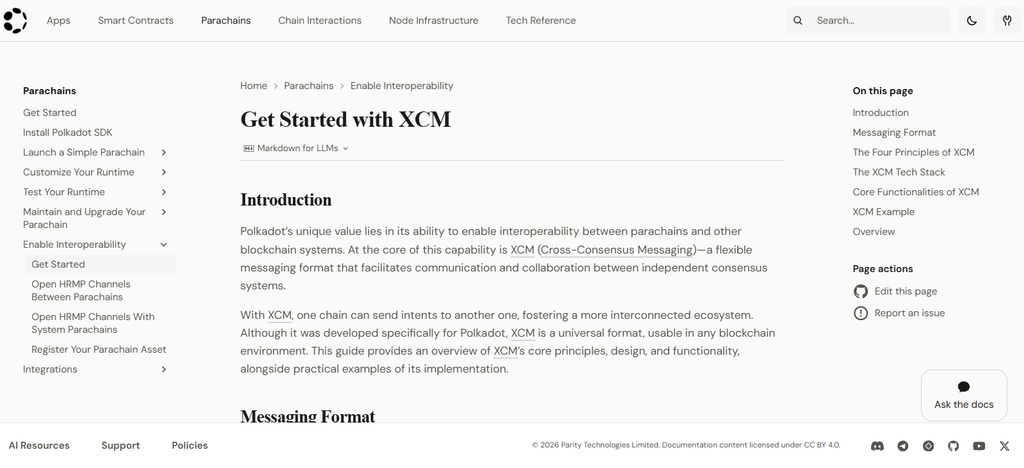
Polkadot’s shared-security architecture and the receiving chain’s interpretation of XCM provide security. Delivery is handled by Polkadot’s interoperability infrastructure, but XCM itself does not carry messages. Supported Environments Polkadot, Kusama, parachains and compatible systems. Costs can be local execution, delivery and remote execution depending on the route .
Best For Polkadot XCMP
- Polkadot parachain messaging
- Asset transfers across blockchains
Blockchain execution in the cloud - Governance across chains
- Polkadot ecosystem dapps.
Why It Stands Out Polkadot Cross-Chain Message (XCM)
- Provides cross-consensus standardized messaging for the Polkadot ecosystems.
- Extends beyond token transfers between compatible chains.
- Supports remote execution and complex instructions across chains.
- Builds on Polkadot’s shared-security architecture.
- Designed to enable robust communication between parachains and other related systems.
8. Avalanche Warp Message
Avalanche Warp Messaging (AWM) Avalanche Warp Messaging (AWM) is Avalanche’s native Cross-L1 communication primitive, allowing Avalanche L1 to communicate arbitrary encoded data. Its security model uses BLS signatures and aggregated multisignatures from the validators, allowing destination networks to verify that enough of the source-validator stake has approved a message.
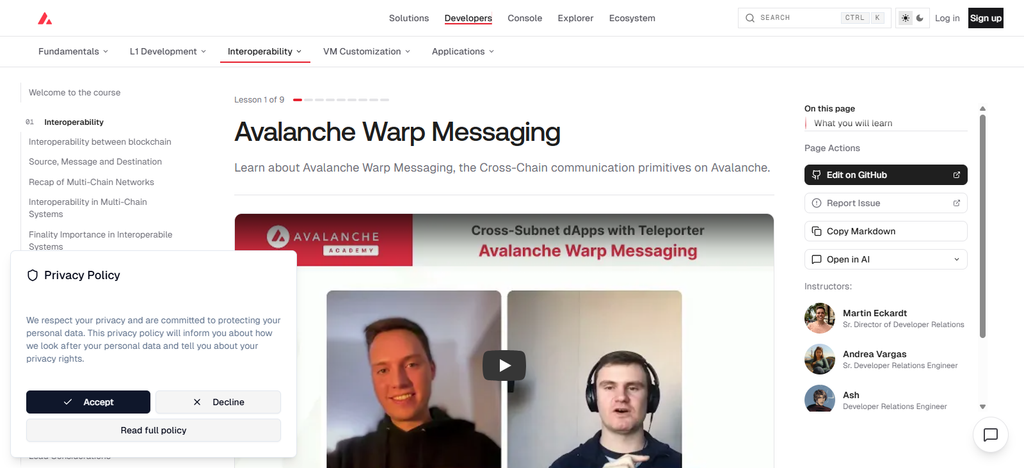
The messages are independent of a central messaging operator. Delivery is from the source Avalanche L1 to the destination L1, using validator signatures and verified by the receiving environment. AWM focuses primarily on Avalanche L1s and compatible VMs. Cost primarily consists of source-chain transaction and execution gas.
Best For Avalanche Warp Messaging (AWM)
- L1 inter-application communication
- Avalanche native messaging
Validator secured data transmission - Use Cases for Avalanche Ecosystem Connectivity
Why It Stands Out Avalanche Warp Messaging (AWM)
- Allows native communication between Avalanche L1 networks.
- Validator-generated BLS signatures for message authentication.
- No dependence on a separate, centralized messaging operator.
- Supports arbitrary data communication among compatible Avalanche networks.
- Focuses on apps directly targeting Avalanche’s growing L1 ecosystem.
9. Interchain Token Service (ITS)
Chainlink Interchain Token Service (ITS) is a Chainlink infrastructure service for creating and managing tokens across supported blockchains, and not a standalone general-purpose messaging protocol. It uses CCIP under the hood for secure cross-chain token communication, and supports standardized token behavior across connected networks.
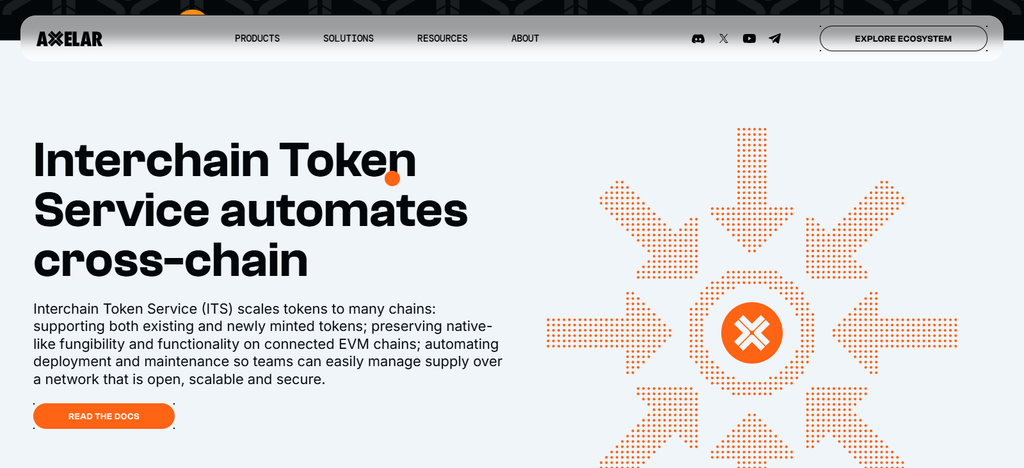
This means that its security inherits CCIP’s architecture of decentralized verification, controls on token pools, and configurable security options. Delivery is the flow of token messages through CCIP through source, verification and destination execution. Supported networks are dependent on current CCIP availability. Fees are based on destination execution, verification, token configuration, and route.
Best For Interchain Token Service (ITS)
- Cross-chain token launches
- Omnichain token ecosystems
Standard token behavior across all chains - Programmable interoperability of tokens
- Projects using Chainlink CCIP infrastructure
Why It Stands Out Interchain Token Service (ITS)
- Explicitly addresses standardized cross-chain token functionality.
- Uses Chainlink CCIP to enable secure token interoperability.
- Helps projects to launch tokens on multiple supported networks.
- Simplifies the complexities around building custom cross-chain token infrastructure.
- Built for projects creating consistent omnichain token experiences.
10. General Message Passing (GMP)
Axelar General Message Passing (GMP) isn’t a standalone interoperability network, it’s Axelar’s cross-chain messaging at the application level. It enables contracts on one supported blockchain to call functions on another, optionally attaching tokens.
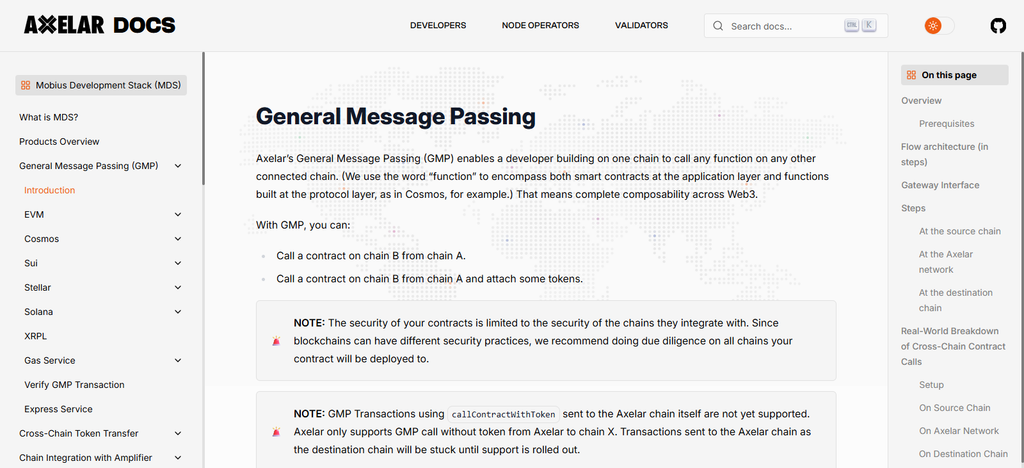
Security is provided by Axelar’s proof-of-stake validator consensus, with payloads being signed before execution at destination. Message life cycle: Submit source Gateway, approve validator, generate signed command, verify destination Gateway, execute contract.
GMP works with EVM and non-EVM chains where the Axelar infrastructure is running. Mainly for Axelar consensus, relaying and destination gas. Costs need prepaid gas for execution.
Best For General Message Passing (GMP)
- Programmable blockchain messaging
- Cross-chain smart contract calls
- Omnichain DeFi apps
- Cross-chain application work flows
- Transmission of data and instructions to supported chains
Why It Stands Out Generalized Message Passing (GMP)
- Enables application logic and programmable cross-chain function calls.
- Can combine any messages and token transfers.
- Leverages Axelar’s decentralized validator security infrastructure.
- Ideal for constructing complex omnichain application workflows.
Conclusion
Cross-chain messaging protocols are set to become the backbone of interoperable blockchain applications in 2026. The most suitable choice depends on your needs for security, supported networks, message verification, delivery architecture, fees and developer experience.
There are many different implementations of cross-chain communication such as Chainlink CCIP, LayerZero, Wormhole, Axelar, Hyperlane, Cosmos IBC, Polkadot XCM and Avalanche Warp Messaging. Specialized solutions such as Interchain Token Service make token interoperability easier and Axelar GMP enables programmable cross-chain contract calls.
Finally, developers should take trust assumptions, network coverage, execution reliability, cost, and integration complexity into account when choosing a protocol that matches the long-term interoperability requirements of their application.
FAQ
What are cross-chain messaging protocols?
Cross-chain messaging protocols enable applications and smart contracts on different blockchains to communicate. They can transmit instructions, data, token-related commands, governance actions, and contract calls between supported networks.
How does cross-chain messaging work?
A message is created on the source blockchain, verified through the protocol’s security infrastructure, relayed toward the destination network, and then verified and executed by the receiving application or smart contract.
What is the difference between cross-chain messaging and a bridge?
Cross-chain messaging focuses on communicating data or instructions between blockchains, while bridges traditionally emphasize moving assets between networks. Modern interoperability protocols can combine messaging with token-transfer functionality.
Which cross-chain messaging protocol is best in 2026?
There is no universal best protocol. Chainlink CCIP, LayerZero, Wormhole, Axelar, Hyperlane, Cosmos IBC, Polkadot XCM, and Avalanche Warp Messaging have different security architectures, network coverage, costs, and developer requirements.