


In this article I will be talking about the Best Data Availability Platforms for Blockchain and will discuss the leading solutions that are built to help improve scalability, security and efficient data publishing. You’ll learn their DA architecture, consensus, Data Availability Sampling, pricing, throughput, developer tools, integrations, supported ecosystems, tokens and key differences to help you identify the right platform for your blockchain project.
What Are Data Availability Platforms for Blockchain?
Data Availability Platforms for Blockchain are infrastructure networks that ensure the availability of transaction and state data published by rollups, appchains and other blockchain systems for verification when needed. They decouple data availability from execution and settlement allowing networks to scale without requiring every node to execute or store all data.
These platforms may use methods like Data Availability Sampling, erasure coding, cryptographic commitments, validator networks, or Data Availability Committees. They come in different architectures, offering varying degrees of security, throughput, cost-effectiveness, decentralization and flexibility of integration for modern blockchain applications.
How We Selected These 10 DA Platforms
| Selection Criteria | What We Evaluated | Why It Matters |
|---|---|---|
| DA Architecture | Dedicated DA layer, Ethereum-based DA, committee-based DA, or integrated DA model | Shows how each platform handles blockchain data availability |
| Launch & Maturity | Mainnet launch, production readiness, and infrastructure maturity | Helps distinguish established solutions from newer infrastructure |
| Consensus & Security | PoS, Ethereum security, restaking, validator model, or committee assumptions | Determines the level and source of security |
| Data Availability Sampling | DAS implementation, light-client verification, or alternative availability mechanism | Measures how efficiently users can verify published data |
| Erasure Coding | Reed-Solomon or other data-recovery techniques | Indicates how the network protects data against unavailable shares |
| Throughput & Scalability | Data capacity, bandwidth, blockspace, and scalability architecture | Important for high-volume rollups and appchains |
| Pricing | Data publication fees, capacity pricing, Ethereum blob costs, or committee-based economics | Helps projects estimate ongoing DA expenses |
| Developer Tools | SDKs, APIs, nodes, CLI tools, documentation, and integration frameworks | Shows how easily developers can build and deploy |
| Integrations | Rollups, L2s, appchains, Ethereum, modular stacks, and ecosystem integrations | Measures practical compatibility with existing blockchain infrastructure |
| Supported Ecosystems | Ethereum, Cosmos, Arbitrum, Polygon, NEAR, Fuel, Starknet, and other ecosystems | Helps developers identify platforms aligned with their technology stack |
| Token & Economics | Native token, staking, fees, governance, or dependence on another network’s token | Explains the platform’s economic model and potential token requirements |
| Data Retrieval | APIs, namespaces, light clients, storage operators, and data-access mechanisms | Determines how applications and nodes retrieve published data |
| Decentralization | Validator/operator distribution, committee requirements, and trust assumptions | Helps evaluate censorship resistance and availability guarantees |
| Integration Difficulty | Required infrastructure, APIs, SDK maturity, and architectural changes | Shows how much engineering effort may be needed |
| Best Use Case | Rollups, sovereign chains, appchains, gaming, high-throughput applications, or Ethereum L2s | Connects technical capabilities with practical project requirements |
| Key Trade-Offs | Cost vs security, throughput vs decentralization, flexibility vs complexity | Provides a balanced view rather than ranking platforms only by performance |
| 2026 Relevance | Current scaling requirements, blob-based DA, modular architecture, and ecosystem adoption | Keeps the list focused on blockchain infrastructure needs in 2026 |
Key Points
| Data Availability Platform | Key Point |
|---|---|
| Celestia | Modular data availability layer for rollups and appchains |
| Avail | Data availability, interoperability, and shared security platform |
| EigenDA | Ethereum restaking-powered data availability solution |
| Near DA | Low-cost data availability layer built on NEAR infrastructure |
| AnyTrust (Arbitrum) | Off-chain data availability model for scalable rollups |
| Espresso DA | Shared decentralized data availability and sequencing infrastructure |
| Fuel Ignition DA | Modular DA support for Fuel-based ecosystems |
| Polygon AggLayer DA Stack | Data availability support for interconnected ZK chains |
| Starknet Data Availability Modes | Flexible on-chain and off-chain DA options for Starknet |
| LazyLedger-Based DA Networks | Dedicated modular data availability architecture for blockchain scaling |
1. Celestia
Celestia, a modular Data Availability (DA) network, was launched on mainnet in 2023 with the aim to decouple data availability from execution and settlement. It uses Proof-of-Stake consensus, Data Availability Sampling (DAS), Namespaced Merkle Trees and two-dimensional Reed-Solomon erasure coding, which enables light nodes to verify availability without downloading entire blocks.

TIA is used for transaction fees, staking and securing the network. Celestia supports rollups, sovereign chains, and modular blockchain stacks via APIs, SDKs, Blobstream, and ecosystem integrations. Pricing is based on a market for blob sizes. It’s architected for scalable blockspace, with throughput to grow with increased participation in sampling.
| Feature | Details |
|---|---|
| Launch | Mainnet launched in 2023 |
| Category | Modular Data Availability blockchain |
| DA Architecture | Dedicated DA and consensus layer separated from execution and settlement |
| Consensus/Security | Proof-of-Stake with Celestia’s Cosmos-based consensus architecture |
| Data Availability Sampling | Yes; light nodes sample data shares instead of downloading entire blocks |
| Erasure Coding | Yes; two-dimensional Reed-Solomon erasure coding |
| Data Structure | Namespaced Merkle Trees enable applications to retrieve relevant data |
| Token | TIA |
| Token Utility | Staking, transaction/data fees and network security |
| Developer Tools | Celestia nodes, APIs, SDKs, light and bridge nodes |
| Integrations | Rollups, sovereign chains, modular stacks and Rollups-as-a-Service providers |
| Pricing | Data publication fees based on network demand and blob/data usage |
| Throughput | Designed for expandable blockspace and scalable DA capacity |
| Best For | Rollups, sovereign chains and modular blockchain applications |
| Key Differentiator | Combines DAS, erasure coding and namespace-aware data retrieval |
2. Avail
Avail started as a modular Data Availability layer to give rollups and application specific chains scalable blockspace.
Its DA architecture combines Proof-of-Stake security, KZG polynomial commitments, erasure coding and Data Availability Sampling to enable light clients to verify that the published data is available without downloading every block. AVAIL is the network token for economic security, staking and fees. Avail APIs, SDKs, light clients, node software and data-submission interfaces are available for developers to use.
Its ecosystem supports rollups and multiple blockchain stacks, while integrations are built around flexible DA deployments. Avail focuses on elastic blockspace and high-throughput data publishing for modular ecosystems that are growing.
| Feature | Details |
|---|---|
| Launch | Avail DA mainnet launched in July 2024 |
| Category | Modular Data Availability layer |
| DA Architecture | Dedicated blockchain focused on transaction-data availability |
| Consensus/Security | Proof-based security with a validator network and cryptographic DA guarantees |
| Data Availability Sampling | Yes |
| Erasure Coding | Yes; used to support recoverability and sampling |
| Commitment Technology | KZG commitments |
| Token | AVAIL |
| Token Utility | Network participation, fees and economic security |
| Developer Tools | SDKs, APIs, light clients, full nodes and validator software |
| Integrations | Rollups, validiums, optimiums, sovereign rollups and multiple blockchain ecosystems |
| Pricing | Based on data submission and network usage |
| Throughput | Designed around expandable blockspace and scalable data capacity |
| Best For | Multi-ecosystem rollups and applications requiring dedicated DA |
| Key Differentiator | Combines validity-proof-based guarantees with DAS |
3. EigenDA
EigenDA is a decentralized Data Availability service built on top of Ethereum and EigenLayer’s restaking infrastructure, resulting in a different security model than sovereign DA chains. It leverages operators to store and serve encoded data, and attestations to establish availability.
EigenDA V2 unveiled a high-throughput architecture to enable cloud-scale data publishing, reporting sustained throughput of some 100 MB/s, with aspirations for significantly higher capacity. Its ecosystem is heavily focused on Ethereum rollups, appchains and Layer-2 developers.
Developers build through EigenDA APIs, SDKs, dispersers, operators, and integration tooling. There is no simple, universal retail fee model. Prices are set by service arrangements and capacity.
| Feature | Details |
|---|---|
| Launch | Mainnet launched as an EigenLayer-powered DA service |
| Category | Restaking-based Data Availability service |
| DA Architecture | Operator-based distributed data storage and attestation architecture |
| Consensus/Security | Ethereum-aligned economic security through EigenLayer restaking |
| Data Availability Sampling | Not based on the same public DAS model as Celestia or Avail |
| Erasure Coding | Uses coded data distribution across operators |
| Commitments | KZG commitments are used within the data-dispersal architecture |
| Token | Uses EigenLayer/Ethereum economic infrastructure rather than a standalone DA-native token model |
| Developer Tools | Disperser, operator software, APIs and integration tooling |
| Integrations | Ethereum rollups, L2s and modular blockchain stacks |
| Pricing | Capacity/service-based pricing rather than a simple universal gas-fee model |
| Throughput | Built for high-throughput data dispersal and scalable operator infrastructure |
| Best For | Ethereum-aligned rollups and high-volume blockchain applications |
| Key Differentiator | Uses restaked economic security instead of operating as an independent DA blockchain |
4. Near DA
The NEAR Foundation announced NEAR DA, a low-cost Data Availability service for Ethereum rollups and blockchain developers. NEAR DA uses the highly scalable infrastructure of NEAR to provide low-cost data publication and retrieval without requiring developers to build a separate DA blockchain.
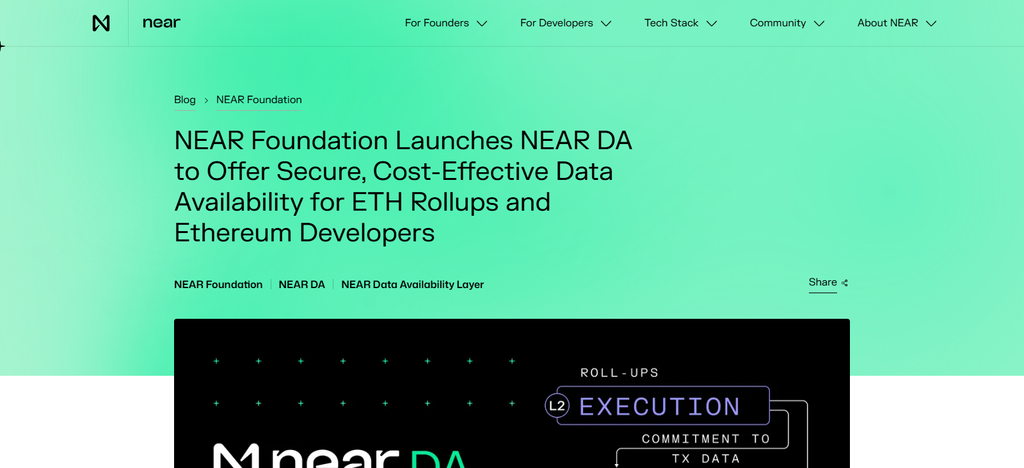
Its architecture is built on top of the NEAR sharded network and existing consensus and validator infrastructure, rather than a traditional dedicated DA chain for DAS. NEAR is its native network Token, and pricing is built around low cost data storage and publishing.
NEAR DA tooling and APIs provide developer access today, with Ethereum rollups and modular blockchain builders integrations coming soon.
| Feature | Details |
|---|---|
| Launch | Introduced as NEAR’s DA service for rollups and developers |
| Category | Blockchain-based Data Availability service |
| DA Architecture | Uses NEAR’s existing scalable network infrastructure |
| Consensus/Security | Inherits security and validator infrastructure from NEAR |
| Data Availability Sampling | Not positioned as a dedicated Celestia-style DAS network |
| Erasure Coding | Not the primary differentiating feature of the service |
| Token | NEAR |
| Token Utility | NEAR ecosystem fees and network economics |
| Developer Tools | DA interfaces, APIs and NEAR development tooling |
| Integrations | Ethereum rollups and modular blockchain infrastructure |
| Pricing | Designed around low-cost data publication |
| Throughput | Benefits from NEAR’s scalable/sharded infrastructure |
| Best For | Rollups seeking cost-efficient DA |
| Key Differentiator | Provides DA through an existing scalable Layer-1 rather than creating a separate DA-only network |
5. AnyTrust (Arbitrum)
Arbitrum AnyTrust is a Data Availability architecture for Arbitrum Nitro chains that trades off some decentralization for much lower data costs. Rather than publishing each batch of transaction data directly to Ethereum, AnyTrust chain uses a permissioned Data Availability Committee (DAC) that stores data and signs Data Availability Certificates.
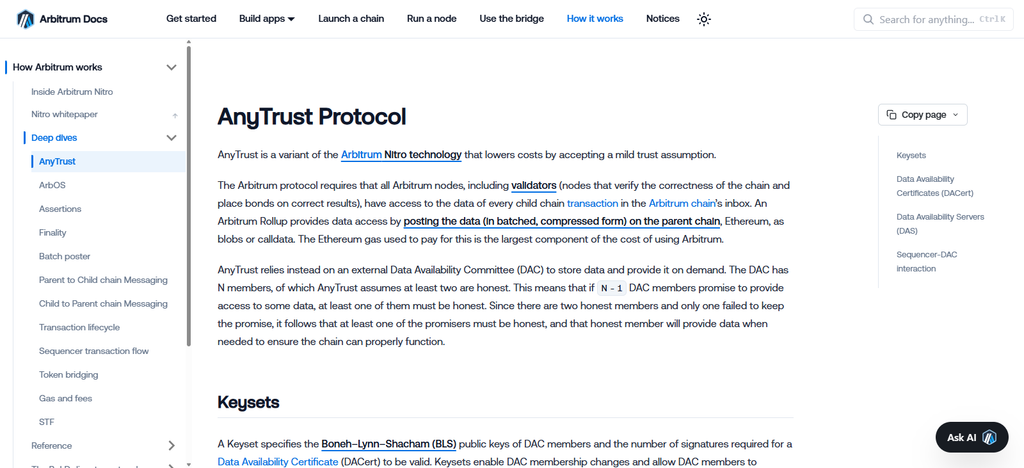
The security model assumes a fixed threshold of honest committee members . AnyTrust does not use DAS in the same way as Celestia or Avail, as availability is provided by committee attestations and data servers and not decentralized sampling. There’s no separate AnyTrust token. Developers are able to leverage Arbitrum Orbit, Nitro tooling, DAC software and Ethereum integration.
| Feature | Details |
|---|---|
| Launch | Introduced as part of Arbitrum Nitro/Orbit chain infrastructure |
| Category | Data Availability Committee-based architecture |
| DA Architecture | A selected committee stores transaction data and provides availability certificates |
| Consensus/Security | Security depends on the configured committee and honest-member threshold |
| Data Availability Sampling | No; availability is established through committee attestations |
| Erasure Coding | Not the central DA mechanism |
| Token | No dedicated AnyTrust token |
| Developer Tools | Arbitrum Nitro, Orbit, DAC tooling and chain configuration |
| Integrations | Arbitrum Orbit chains and Ethereum settlement |
| Pricing | Designed to reduce data costs compared with publishing all data directly to Ethereum |
| Throughput | Designed for low-cost, scalable chain data publication |
| Best For | Application-specific Arbitrum chains prioritizing lower DA costs |
| Key Differentiator | Trades some decentralization for lower data-publication costs |
6. Espresso DA
Espresso provides Data Availability as part of a larger modular base-layer architecture that also includes decentralized sequencing, fast confirmations, and DA services. It’s built to work with other DA providers, meaning rollups can use Espresso for sequencing and confirmations, but choose Celestia, EigenDA, Avail, Ethereum or another DA system if it makes sense.
Its security depends on the decentralized consensus of Espresso more than a traditional Ethereum blob-only model. Espresso’s roll-up infrastructure, node software, APIs, and stack-specific plug-ins allow developers to plug in.
Espresso is ready for Arbitrum Nitro and other modular stacks with cross-ecosystem integrations. Its main differentiator is combining fast finality and DA, not just focusing on DA blockspace.
| Feature | Details |
|---|---|
| Launch | Developed as part of Espresso’s modular blockchain infrastructure |
| Category | Modular sequencing and DA infrastructure |
| DA Architecture | DA integrated with decentralized sequencing and confirmation infrastructure |
| Consensus/Security | Uses Espresso’s decentralized consensus and network participants |
| Data Availability Sampling | Not its primary differentiator |
| Erasure Coding | Architecture can work with external DA configurations |
| Token | Espresso ecosystem/token economics depend on network deployment |
| Developer Tools | Espresso infrastructure, APIs, node software and rollup integrations |
| Integrations | Arbitrum Nitro and other modular rollup stacks |
| Pricing | Depends on selected Espresso services and network usage |
| Throughput | Designed for fast confirmations and scalable modular infrastructure |
| Best For | Rollups needing decentralized sequencing alongside modular infrastructure |
| Key Differentiator | Combines sequencing, fast confirmations and DA-related infrastructure |
7. Fuel Ignition DA
Fuel Ignition leverages Ethereum as its Layer-1 settlement and Data Availability foundation, meaning Fuel rollup can rely on Ethereum’s security model, rather than depending on a separate DA network. Fuel batches transaction data, compresses it and publishes it in Ethereum blobspace, making its DA architecture EIP-4844 compatible.
It does not run a separate Fuel-native DAS or erasure coding DA network, in the same model as Celestia does. Developers build on the Fuel toolchain, SDKs and Ethereum-compatible infrastructure.
Fuel’s modular architecture could be used to support alternative DA systems such as Celestia and Avail. Ethereum provides core DA security and FUEL is the ecosystem token.
| Feature | Details |
|---|---|
| Launch | Fuel Ignition is Fuel’s Ethereum-settled mainnet environment |
| Category | Rollup-based Ethereum DA architecture |
| DA Architecture | Uses Ethereum as the primary settlement and DA foundation |
| Consensus/Security | Inherits core security from Ethereum settlement |
| Data Availability Sampling | No native Fuel-specific DAS network |
| Erasure Coding | Relies on Ethereum’s blob/data infrastructure rather than a dedicated Fuel DA layer |
| Token | FUEL |
| Developer Tools | Fuel SDK, toolchain, APIs and development framework |
| Integrations | Ethereum and Fuel ecosystem applications |
| Pricing | Primarily affected by Ethereum data-publication economics |
| Throughput | Benefits from Ethereum blobspace and Fuel’s execution architecture |
| Best For | Developers building Fuel-based rollups and applications |
| Key Differentiator | Combines Fuel execution with Ethereum-backed settlement and DA |
8. Polygon AggLayer DA Stack
Polygon’s AggLayer is more of an interoperability and aggregation architecture rather than a stand-alone DA network like Celestia or Avail. It aims to connect multiple chains and manage the proofs, liquidity and cross-chain state, while the individual chains can decide their own data-availability arrangements.
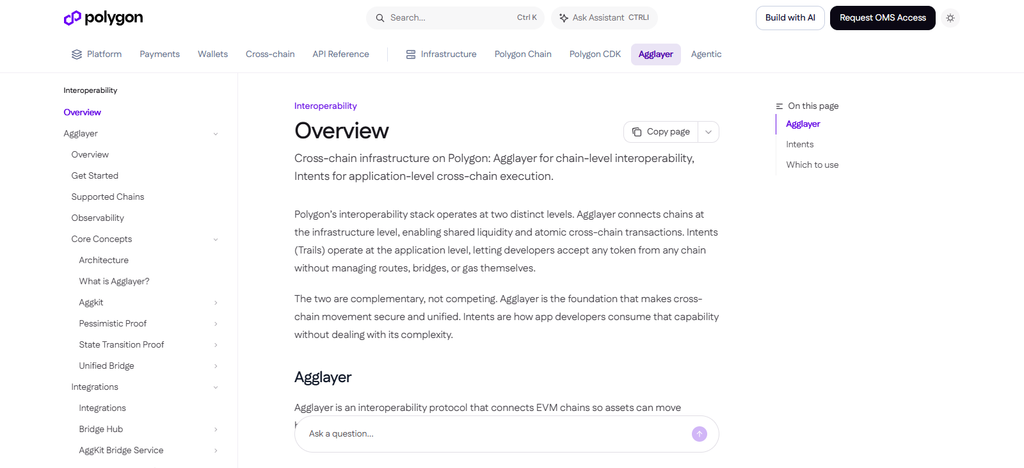
Consequently, there is no AggLayer-native DAS, erasure-coding system, or universal DA throughput figure. Polygon CDK based chains can use either Ethereum, validium style DA, DAC configurations or other modular infrastructure depending on the deployment.
POL is the ecosystem token of Polygon. Developer tooling: Polygon CDK, AggLayer components, bridges, proof infrastructure, chain-development tools Its main benefit is the integrated interoperability of the Polygon chains participating, instead of the dedicated DA specialization.
| Feature | Details |
|---|---|
| Launch | Developed as part of Polygon’s broader modular scaling architecture |
| Category | Aggregation/interoperability infrastructure with flexible DA options |
| DA Architecture | Not a single independent DA blockchain; individual chains can use different DA configurations |
| Consensus/Security | Depends on the underlying chain and selected DA configuration |
| Data Availability Sampling | Depends on the chosen DA provider |
| Erasure Coding | Depends on the underlying DA architecture |
| Token | POL |
| Developer Tools | Polygon CDK, AggLayer tooling, proof infrastructure and chain-development tools |
| Integrations | Polygon CDK chains and connected blockchain ecosystems |
| Pricing | Depends on the selected chain and DA configuration |
| Throughput | Designed to aggregate activity across multiple chains rather than provide one DA throughput figure |
| Best For | Interconnected Polygon-based chains and aggregated liquidity |
| Key Differentiator | Focuses on chain aggregation and interoperability rather than operating as a standalone DA layer |
9. Starknet Data Availability Modes
Starknet takes a different approach to Data Availability with its rollup architecture, ultimately anchoring the transaction and state information needed for verification to Ethereum settlement. The DA model of it has evolved around Ethereum calldata and blob-based data availability, with different data-publication choices affecting cost and scalability.
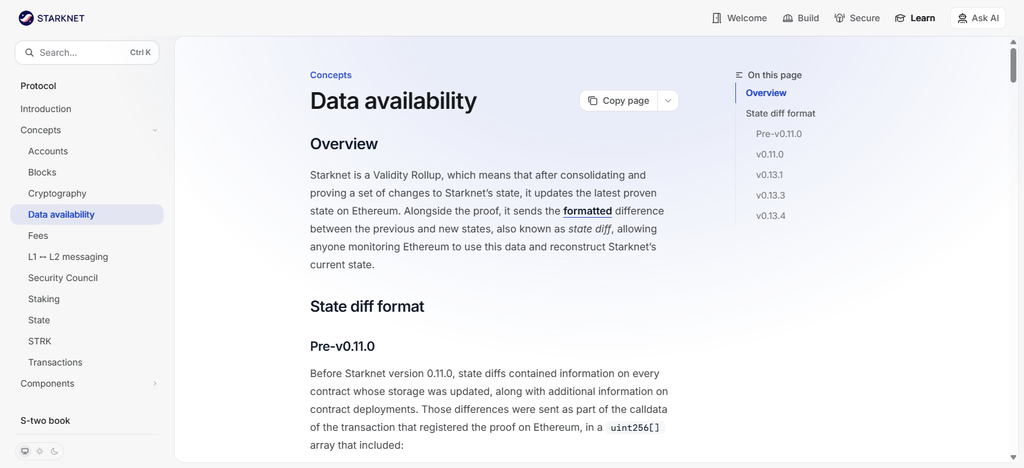
Starknet does not have its own DAS and erasure-coded sampling architecture, as a standalone Celestia-style DA network would. Starknet gives developers the SDKs, RPC interfaces, sequencer infrastructure and Ethereum integration tools.
STRK is the native token of the ecosystem that will be used in Starknet’s broader economic and governance structure. Its DA economics depend heavily on data costs on Ethereum, while future scaling improvements can take advantage of Ethereum’s growing blob capacity.
| Feature | Details |
|---|---|
| Launch | Starknet launched as an Ethereum Layer-2 ecosystem |
| Category | ZK-rollup with Ethereum-based DA |
| DA Architecture | Transaction/state data is ultimately tied to Ethereum settlement and data publication |
| Consensus/Security | ZK-proof-based security with Ethereum settlement |
| Data Availability Sampling | No independent Starknet-native DAS network |
| Erasure Coding | Relies on the underlying Ethereum DA architecture rather than a Starknet-specific DA network |
| Token | STRK |
| Developer Tools | Cairo, Starknet SDKs, RPC interfaces and developer tooling |
| Integrations | Ethereum ecosystem, wallets, bridges and Starknet applications |
| Pricing | Influenced by Ethereum data costs and Starknet transaction economics |
| Throughput | Scaling benefits from Starknet’s ZK-rollup architecture and Ethereum blob infrastructure |
| Best For | ZK applications and Ethereum-aligned scaling |
| Key Differentiator | Uses ZK proofs and Ethereum settlement rather than an independent DA layer |
10. LazyLedger-Based DA Networks
The original idea that became Celestia, LazyLedger, presented the modular DA design which separates consensus and data availability from execution. Modern networks based on LazyLedger usually apply approaches like erasure coding, data commitments, light client verification, and in some designs Data Availability Sampling to enable blockchain applications to post huge amounts of data without every node executing all of it.
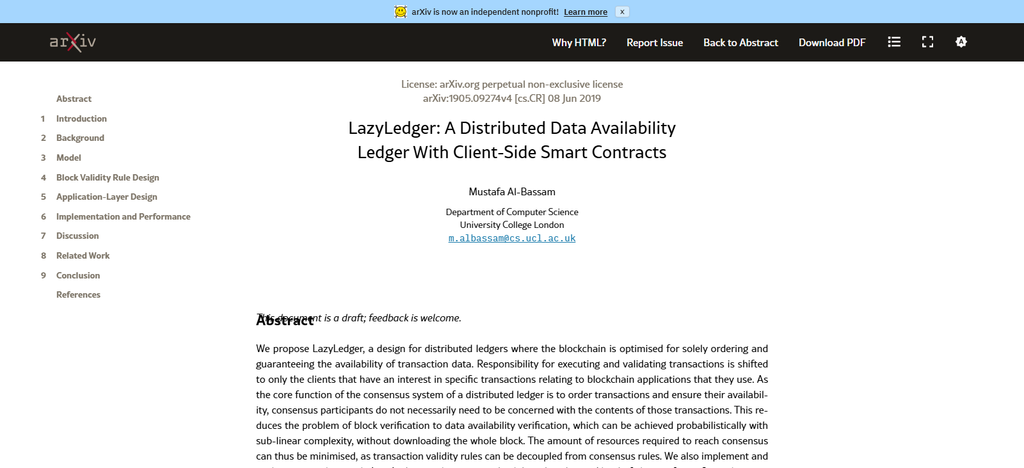
Celestia is the most direct production implementation of this architecture, but other modular DA projects have applied related principles with different consensus, security, pricing, and throughput models. Developer tooling typically consists of APIs, SDKs, light clients, node software and rollup integrations depending on the network in question.
| Feature | Details |
|---|---|
| Origin | LazyLedger was the early modular DA concept that evolved into Celestia |
| Category | Modular Data Availability architecture |
| DA Architecture | Separates consensus and DA from execution |
| Consensus/Security | Varies by modern implementation |
| Data Availability Sampling | Core concept associated with the architecture |
| Erasure Coding | Fundamental technique for reconstructing unavailable data |
| Data Structure | Modern implementations may use commitments, Merkle structures and namespaces |
| Token | Depends on the specific implementation |
| Developer Tools | APIs, SDKs, light clients and node software vary by network |
| Integrations | Rollups, sovereign chains and modular execution environments |
| Pricing | Depends on the specific DA network |
| Throughput | Designed to scale DA independently from execution |
| Best For | Modular blockchain infrastructure |
| Key Differentiator | Separates data availability from execution and settlement |
Conclusion
As rollups, appchains and modular networks keep scaling in 2026, data availability is becoming a fundamental part of scalable blockchain infrastructure.
Platforms like Celestia, Avail, EigenDA, NEAR DA and AnyTrust provide different approaches to security, cost, throughput and data verification, while solutions such as Espresso, Fuel, Polygon AggLayer and Starknet integrate DA into broader scaling architectures.
The best choice depends on a project’s security needs, volume of transaction data, ecosystem fit, budget and decentralization goals. Developers should consider trust assumptions, availability guaranties, integration complexity, pricing, and long-term scalability before choosing a DA architecture.
FAQ
What are Data Availability Platforms?
Data Availability Platforms provide infrastructure that allows blockchain networks, rollups, and appchains to publish transaction data and ensure that other participants can access and verify that data when required. They help separate data availability from execution and settlement, improving scalability and reducing the amount of data individual nodes may need to process.
Data Availability important for blockchain projects?
Data availability is important because validators and users need access to transaction data to verify blockchain state and detect invalid behavior. A reliable DA solution can help rollups process more transactions while maintaining verifiability, scalability, and predictable data-publication costs.
Which is the best Data Availability platform in 2026?
There is no single best platform for every blockchain project. Celestia and Avail are strong options for dedicated modular DA, EigenDA is designed around Ethereum-aligned restaking infrastructure, while NEAR DA emphasizes cost-efficient data publishing. The right choice depends on security, throughput, ecosystem, pricing, and integration requirements.
What is Data Availability Sampling?
Data Availability Sampling, or DAS, allows light nodes to check whether blockchain data is available without downloading an entire block. The system uses encoded data and cryptographic commitments so nodes can sample portions of the data and gain confidence that the complete dataset can be recovered.
What is the difference between Data Availability and data storage?
Data availability focuses on ensuring that required blockchain data can be accessed and verified when needed. Data storage generally focuses on retaining data for a particular period or application. A DA system may provide availability guarantees without being designed as a permanent archival storage service.