


In this article, I’ll be going over the Best Blockchain Indexing Protocols for Developers, comparing the top solutions based on their indexing models, supported blockchain networks, query methods, pricing, integrations, historical data, real-time performance, scalability, and developer experience. This guide will help developers understand the key differences between indexing protocols and how to choose the right solution for building reliable, scalable, data-driven blockchain applications.
What Are Blockchain Indexing Protocols for Developers?
Blockchain indexing protocols are developer infrastructure tools that convert raw blockchain data into structured, searchable information. Rather than depending on RPC nodes to continuously scan blocks, transactions and smart-contract events, developers are able to leverage indexers to rapidly discover both historical and live data.
These protocols enhance data access, query speed, scalability, and developer productivity to enable applications such as DeFi dashboards, NFT marketplaces, wallets, analytics platforms and Web3 applications.
How To Choose Blockchain Indexing Protocols for Developers
Blockchain Networks Supported: Check that the protocol supports the chains used by your application, EVM or non-EVM chains, and new chains can be added easily.
Data Coverage: Blocks, transactions, smart-contract events, token transfers, NFTs, wallet activity, DeFi data, and custom application data are supported.
Query Options: Choose between GraphQL, REST APIs, SQL, custom APIs or streaming interfaces depending on your application’s needs for querying indexed data.
Performance in Real Time: If your application requires live dashboards, trading data, alerts or event-driven functionality, select a solution that can process new blockchain events quickly.
Historical Backfill: Test the indexer’s ability to handle older blockchain data. This is important when building analytics apps that depend on large amounts of historical data.
Reorg Handling: Think about how the protocol deals with blockchain reorganizations to ensure consistency and reliability of indexed app data.
Scalability: Review the scalability of the platform based on transaction volume, multiple chains, larger datasets, and high query loads without significant performance degradation.
Deployment Choices: Choose managed infrastructure, self-hosting, or a hybrid model to meet your needs for control, maintenance, security, and infrastructure management.
Dev Experience: Evaluate SDKs, language support, documentation, command line tools, templates, debugging, and the development experience.
Integrations: Check compatibility with databases, cloud services, APIs, webhooks, analytical tools, messaging systems, and any other infrastructure your application uses.
Pricing and Cost-Efficiency: Price is not the be-all and end-all. Compare free tiers, query limits, compute usage, storage costs, streaming charges, and infrastructure expenses.
Reliability and Availability: In production, prioritize indexing services with dependable infrastructure, monitoring, recovery, and consistent data delivery.
Security: If you are going to use an indexing service for production workloads, review access control, API authentication, infrastructure security, data isolation, and deployment practices.
Top Use Case: And finally, match the protocol to your application, whether you need decentralized subgraphs, multi-chain analytics, real-time streams, historical data processing, or custom code-first indexing.
Key Points
| Blockchain Indexing Protocol | Key Point |
|---|---|
| The Graph | Leading decentralized indexing protocol for Web3 data |
| SubQuery | Multi-chain indexing across EVM and non-EVM networks |
| SQD (Subsquid) | High-performance multi-chain indexing and analytics |
| Envio | Fast developer-focused blockchain indexing framework |
| Goldsky | Managed real-time subgraph and data pipeline platform |
| Ponder | TypeScript-based indexing framework for EVM chains |
| Alchemy Subgraphs | Managed indexing service integrated with Alchemy infrastructure |
| Covalent GoldRush | Unified indexed blockchain data API platform |
| QuickNode Streams | Real-time blockchain data streaming and indexing |
| Moralis | Web3 data indexing APIs and developer infrastructure |
1. The Graph
Created in 2018, The Graph is a decentralized blockchain indexing and querying protocol built on Subgraphs with additional Substreams infrastructure for high-throughput data streaming. It supports 60+ networks including Ethereum, Arbitrum, Base, Polygon, Avalanche, BNB Chain, Solana and other ecosystems.
Developers are able to define schemas and mappings and query indexed entities using GraphQL. Indexed Subgraphs and block-based queries allow you to query historical data. Graph Explorer, Subgraph Studio, and Graph CLI for Developers. All pricing includes a free monthly allowance of 100,000 queries and paid thereafter. Its primary benefit is decentralized, composable indexing.
| Characteristic | Details |
|---|---|
| Type | Decentralized blockchain data indexing protocol |
| Core Technology | Subgraphs, Substreams and Amp |
| Indexing Model | Decentralized indexing with distributed Indexers |
| Query Method | GraphQL |
| Network Coverage | 60+ supported networks |
| Data Processing | Contract events, entities and blockchain data |
| Historical Data | Supported through Subgraphs and high-throughput Substreams |
| Real-Time Capability | Substreams provides high-throughput streaming |
| Developer Experience | Subgraph schemas, mappings, CLI and Graph Studio |
| Decentralization | Strong; data is served through independent Indexers |
| Performance | Designed for scalable queries and low-latency blockchain data |
| Integrations | GraphQL applications, Substreams sinks and Web3 applications |
| Best For | DeFi, NFTs, analytics, governance and dApp frontends |
| Key Characteristic | Decentralized and composable blockchain data infrastructure |
2. SubQuery
SubQuery is a blockchain data indexing platform founded in 2021 that offers an open-source SDK to build custom indexing projects. The network supports 300+ blockchain networks including EVM, Cosmos, Polkadot, NEAR, Solana, Stellar, Algorand, Starknet and more ecosystems.
Developers are able to use JavaScript/TypeScript-based tooling to build indexing logic and expose structured blockchain data through APIs, including GraphQL-oriented workflows. SubQuery provides multi-chain projects and historical indexing, which is useful for applications requiring custom datasets.
Pricing is determined by deployment and infrastructure needs. Blockchain integration may incur additional costs. Its biggest advantage is the chain coverage and developer flexibility.
| Characteristic | Details |
|---|---|
| Type | Open-source blockchain indexing platform |
| Indexing Model | Customizable project-based indexing |
| Query Method | GraphQL and custom APIs |
| Network Coverage | 300+ networks |
| Supported Ecosystems | EVM, Cosmos, Polkadot, Solana, Stellar, Algorand, NEAR and Starknet |
| Development | SubQuery SDK |
| Programming | JavaScript/TypeScript-oriented development |
| Historical Data | Supported through indexed projects and backfills |
| Multi-Chain | Strong multi-ecosystem capability |
| Deployment | Hosted and decentralized deployment options |
| Performance | Designed for flexible and scalable Web3 indexing |
| Integrations | APIs, SDKs, supported chain infrastructure and AI applications |
| Best For | Multi-chain dApps and developers needing custom indexing |
| Key Characteristic | Very broad blockchain coverage |
| Notable Strength | 304 networks listed in its current network directory |
3. SQD (Subsquid)
SQD (formerly known as Subsquid) was founded in 2021 and is focused on high performance blockchain data extraction, transformation and querying. The architecture separates pre-indexed Archives from customizable Squids, allowing developers to pull historical blockchain data and apply their own processing logic.
Data across 120+ networks via SQD’s Portal API SQD’s developer ecosystem includes GraphQL, SQL-oriented workflows, SDKs and streaming interfaces. Historical backfill is a huge strength as developers are able to process large ranges of blocks without having to run their own archive infrastructure. Pricing depends on the data-access model and usage you select. The main advantage is customizable high throughput data access.
| Characteristic | Details |
|---|---|
| Type | Open-source Web3 data indexing and ETL toolkit |
| Indexing Model | Modular ETL and customizable Squids |
| Core Infrastructure | SQD Network and decentralized data lake |
| Query/Data Access | APIs, GraphQL and programmable data processing |
| Supported Networks | EVM, Ethereum-like chains, Substrate and Solana, with broader ecosystem tooling |
| Development | TypeScript-based Squid SDK |
| Historical Data | Strong historical extraction and backfill capabilities |
| Data Processing | Blocks, events, transactions and decoded blockchain data |
| Performance | High-throughput data extraction using optimized codecs |
| Deployment | Self-hosted and SQD Network-based workflows |
| Integrations | TypeScript, GraphQL, databases and custom data pipelines |
| Best For | Custom indexing, analytics and large historical datasets |
| Key Characteristic | High-performance customizable data extraction |
| Developer Control | High control over processing and database schema |
4. Envio
Envio was created in 2023 as an open-source real-time blockchain indexer built on HyperIndex and HyperSync. It is primarily focused on EVM networks but is expanding to other ecosystems, with developers writing indexing handlers in TypeScript and other supported languages.
Its query layer offers GraphQL APIs and HyperSync accelerates the retrieval and backfilling of historical data. Developers are able to self-host Envio or use its hosted infrastructure, so it’s flexible for development and production.
It offers integrations like Docker-based workflows, APIs, and developer tooling. Usage based pricing for hosted or infrastructure. Its biggest strength is fast sync and a good TypeScript dev experience.
| Characteristic | Details |
|---|---|
| Type | Open-source blockchain indexing framework |
| Indexing Model | Event-driven, code-first indexing |
| Core Technology | HyperIndex and HyperSync |
| Query Method | GraphQL and application APIs |
| Primary Coverage | EVM networks |
| Development | TypeScript-oriented |
| Historical Backfill | HyperSync enables rapid historical data retrieval |
| Real-Time Data | Designed for real-time event indexing |
| Performance | High-speed synchronization and indexing |
| Deployment | Self-hosted and managed options |
| Data Processing | Smart-contract events and custom handlers |
| Integrations | TypeScript applications, APIs, databases and Web3 infrastructure |
| Best For | EVM developers and production dApps |
| Key Characteristic | Fast code-first indexing |
| Developer Experience | Strong local development and custom event-handling workflow |
5. Goldsky
Goldsky (launched in 2022) is a managed blockchain data platform that brings together Subgraphs, Turbo pipelines, Edge RPC and data feeds. It supports 150+ chains and 270+ networks, giving developers extensive multi-chain coverage.
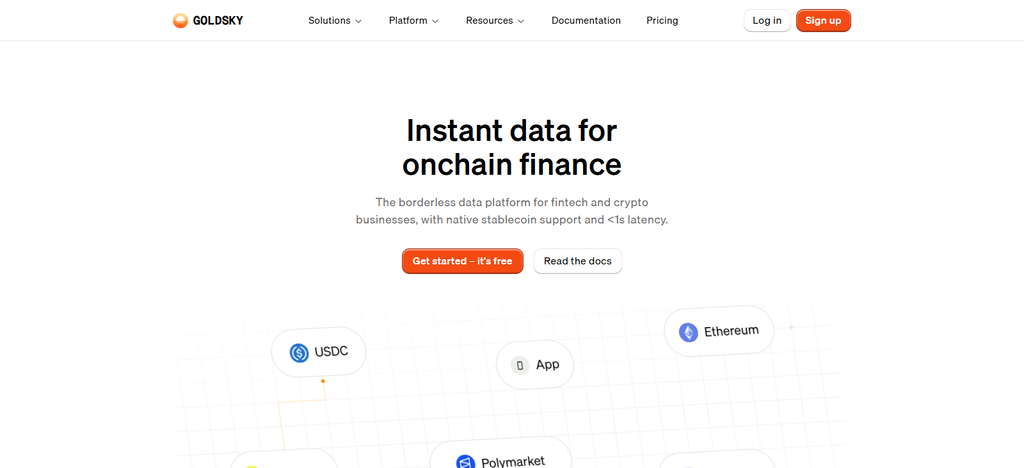
Goldsky Subgraphs offer familiar GraphQL APIs and compatibility with existing Graph-based subgraph schemas, with its pipeline infrastructure facilitating streaming data into external systems. Provides historical indexing, backfills, real-time webhooks, automatic chain-reorganization handling.
Integrations: Databases, data pipelines, webhooks. Free trial: $100 in credits for 30 days, then pay for what you use. The main benefit is managed infrastructure with great real time indexing and migration compatibility.
| Characteristic | Details |
|---|---|
| Type | Managed blockchain data infrastructure |
| Core Products | Subgraphs, data pipelines, webhooks and streaming |
| Indexing Model | Managed indexing and real-time data pipelines |
| Query Method | GraphQL and custom APIs |
| Network Coverage | 150+ chains according to current platform materials |
| Historical Data | Supported with indexing and backfill workflows |
| Real-Time Data | Strong real-time streaming and webhooks |
| Reorg Handling | Automatic chain-reorganization handling |
| Performance | Sub-second indexing latency claimed for Subgraphs |
| Integrations | Webhooks, databases, data pipelines and APIs |
| Migration | Compatible with The Graph-style Subgraphs |
| Deployment | Fully managed |
| Best For | Production dApps and real-time data pipelines |
| Key Characteristic | Managed, high-availability indexing |
| Developer Benefit | Low infrastructure-maintenance requirement |
6. Ponder
Ponder is an open-source, code-first framework for indexing blockchains for developers who want to use TypeScript and own the application logic. Primarily it is focused on EVM compatible networks and allows developers to define contracts, event handlers and data transformations in code. Indexed information may be stored in PostgreSQL and made available through GraphQL, SQL or application specific interfaces.
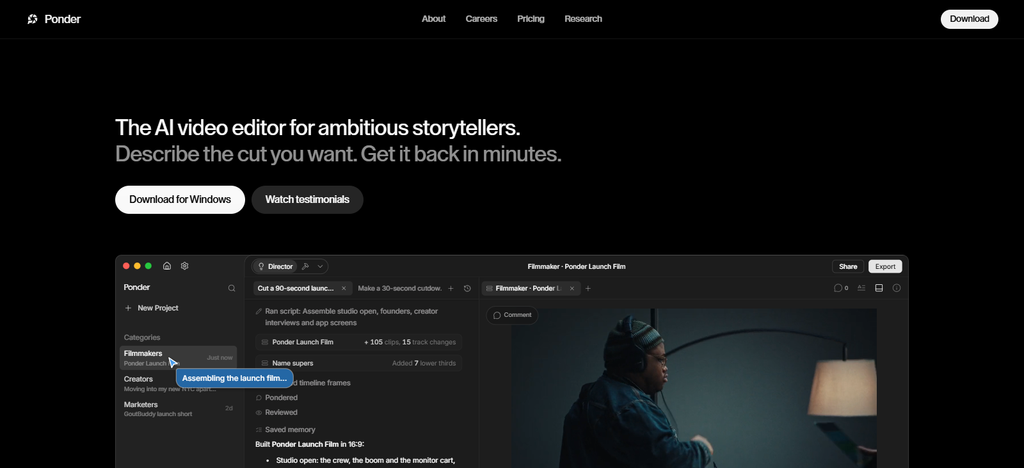
Ponder supports local development, hot reload and self-managed deployment, giving teams control over infrastructure and database design. The framework itself is open-source and you don’t need to pay for a traditional hosted indexing subscription. Its biggest advantage is a flexible developer architecture.
| Characteristic | Details |
|---|---|
| Type | Open-source blockchain indexing framework |
| Indexing Model | Code-first indexing |
| Primary Coverage | EVM-compatible networks |
| Development Language | TypeScript |
| Query Method | Application-specific APIs, GraphQL and database queries |
| Database | PostgreSQL-oriented architecture |
| Historical Data | Supports blockchain synchronization and historical indexing |
| Customization | Very high; developers define event handlers and data models |
| Deployment | Self-hosted |
| Performance | Designed for efficient application-specific indexing |
| Integrations | TypeScript applications, PostgreSQL and Web3 infrastructure |
| Best For | Developers wanting direct control over indexing logic |
| Key Characteristic | Simple code-first developer experience |
| Infrastructure Control | High |
| Cost Model | Open-source framework; infrastructure costs depend on deployment |
7. Alchemy Subgraph
A 2026 article should treat Alchemy Subgraphs differently as the service was sunset on December 8, 2025 and its subgraph and query endpoints were shut down. Prior to deprecation it offered managed subgraph-based blockchain indexing with GraphQL-style data access, and was integrated with Alchemy’s wider developer infrastructure.
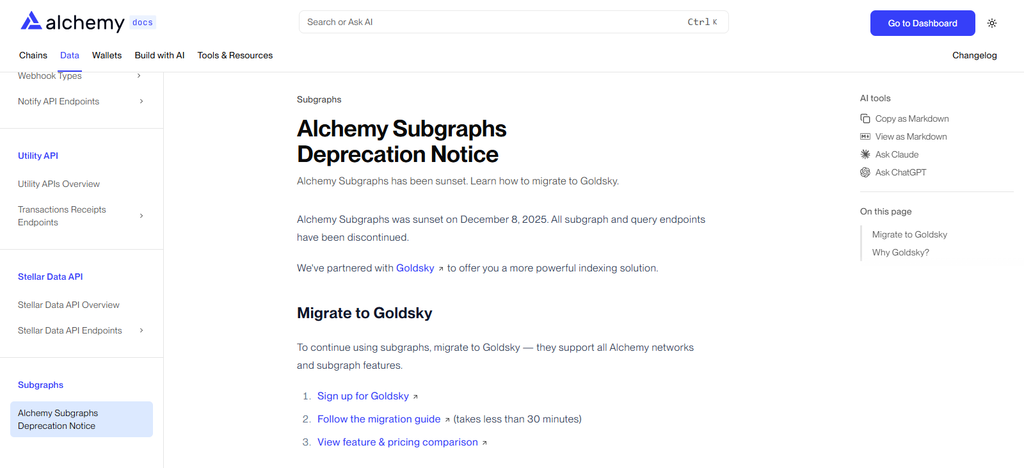
Alchemy then partnered with Goldsky and told developers to migrate for continued subgraph functionality. So it’s not an active blockchain indexing protocol in 2026. If you keep it in the article, describe it as a deprecated indexing service and migration reference. Goldsky is its successor, not a contemporary competitor.
| Characteristic | Details |
|---|---|
| Type | Managed blockchain indexing service |
| Former Indexing Model | Managed Subgraph infrastructure |
| Query Method | GraphQL |
| Network Coverage | Alchemy-supported networks |
| Historical Data | Previously supported through Subgraph indexing |
| Developer Experience | Subgraph-based development |
| Integrations | Alchemy developer infrastructure |
| Status in 2026 | Discontinued |
| Sunset Date | December 8, 2025 |
| Current Availability | Subgraph and query endpoints discontinued |
| Migration Option | Goldsky |
| Replacement | Goldsky Subgraphs and related data infrastructure |
| Key Historical Characteristic | Managed Graph-compatible indexing |
| 2026 Recommendation | Do not treat as an active indexing platform |
| Editorial Use | Mention as a deprecated option or migration case |
8. GoldRush Covalent
Covalent GoldRush is built on Covalent’s blockchain-data infrastructure, first launched in 2017 and is centered around providing normalized, multi-chain blockchain data via developer APIs, as opposed to requiring teams to build custom indexers from scratch.
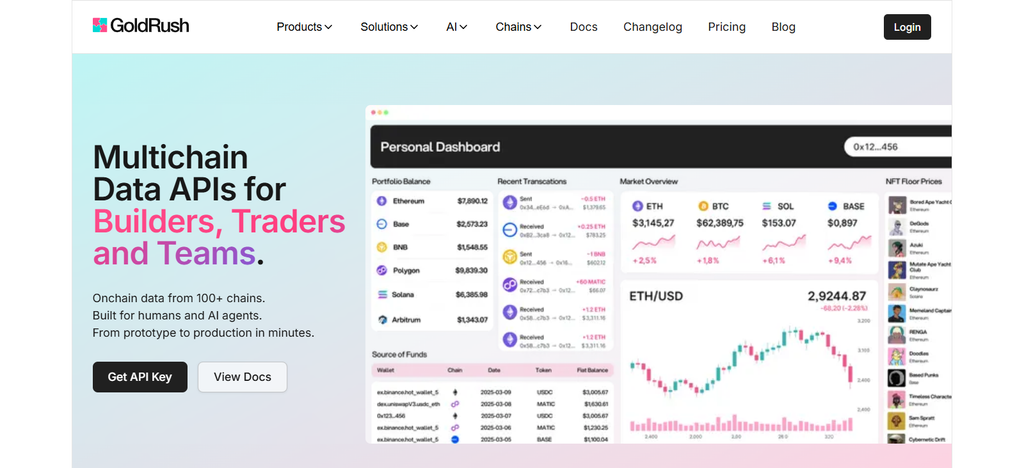
GoldRush offers structured access to wallet, token, transaction, NFT and historical blockchain data, useful for portfolios, analytics platforms and data-driven dApps. Its API-oriented model abstracts much of the underlying indexing infrastructure and supports integrations via standard developer requests.
Part of its value proposition is availability of historical data. Pricing depends on plan and API usage. Main Strength: Convenient, normalized access to cross-chain data for application developers.
| Characteristic | Details |
|---|---|
| Type | Multi-chain blockchain data API |
| Core Product | GoldRush API |
| Indexing Model | Managed and normalized blockchain data infrastructure |
| Query Method | APIs |
| Network Coverage | 100+ blockchains according to current comparison materials |
| Data Types | Wallet, token, NFT, transaction and on-chain data |
| Historical Data | Broad historical blockchain datasets |
| Data Format | Normalized and structured |
| Developer Experience | API-first integration |
| Integrations | Web3 applications, dashboards and AI/data applications |
| Performance | Designed for fast application-level blockchain data retrieval |
| Deployment | Fully managed |
| Best For | Wallets, dashboards, analytics and multi-chain applications |
| Key Characteristic | Simplified normalized cross-chain data |
| Developer Benefit | Less custom indexing infrastructure required |
9. QuickNode Streams
Founded in 2017, QuickNode offers Streams as a managed real-time and historical blockchain data pipeline, not a traditional subgraph-only indexer. Streams supports 60+ blockchain networks like Ethereum, Solana, Bitcoin, Arbitrum, Base, Polygon, and Avalanche.
Developers are able to send stream blocks, receipts, traces, logs, and chain-specific datasets to destinations like webhooks, S3, PostgreSQL, Azure Blob, and Kafka. Custom transformations can be made before delivery using server-side JavaScript or Go filters.
Streams also has support for historical backfills, batch, compression and reorganization handling, including exactly-once delivery for supported data. Pricing is consumption based via QuickNode infrastructure The power is in flexible real-time data pipelines.
| Characteristic | Details |
|---|---|
| Type | Managed blockchain data streaming infrastructure |
| Indexing Model | Real-time and historical data streaming |
| Query/Data Method | Streams, APIs and programmable filters |
| Network Coverage | Multiple major blockchain networks |
| Data Types | Blocks, transactions, logs, receipts and chain-specific data |
| Historical Backfill | Supported |
| Real-Time Capability | Strong |
| Processing | Custom server-side filtering and transformation |
| Destinations | Webhooks, databases, cloud storage and streaming systems |
| Integrations | PostgreSQL, S3, Kafka, Azure and Web3 applications |
| Deployment | Fully managed |
| Performance | Designed for scalable data delivery |
| Best For | Bots, alerts, analytics and real-time applications |
| Key Characteristic | Flexible blockchain-to-destination data pipelines |
| Developer Benefit | Avoids maintaining custom streaming infrastructure |
10. Moralis
Founded in 2021, Moralis is a managed Web3 data platform that provides structured blockchain APIs, RPC infrastructure and Moralis Streams instead of a traditional decentralized indexer.
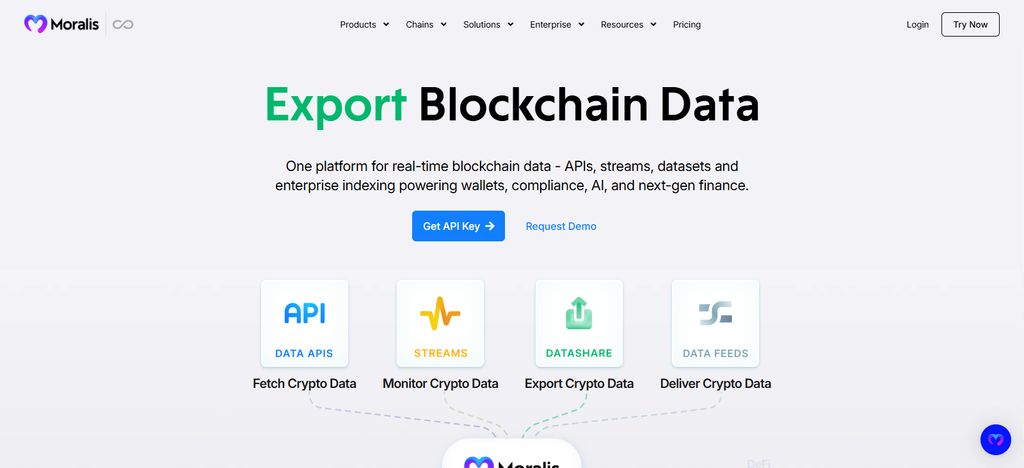
Its Data API provides normalized access to wallet, token, NFT, price, DeFi and blockchain activity data from supported EVM and non-EVM networks including Ethereum, Solana, Base, BNB Chain, Polygon, Avalanche, Arbitrum and others.
Developers primarily query data through ** REST APIs ** and Streams provides events in real time. Historical blockchain data is available, however some historical backfill services may be charged separately. The current annual-billing plans start at $149/month with additional tiers for more throughput.
| Characteristic | Details |
|---|---|
| Type | Managed Web3 data platform |
| Core Products | Data APIs, RPC infrastructure, Streams and Data Indexer |
| Indexing Model | Managed indexing with pre-built and customizable data schemas |
| Query Method | REST APIs and application integrations |
| Network Coverage | Multi-chain EVM and selected non-EVM support |
| Data Types | Wallet, token, NFT, DeFi, price and transaction data |
| Historical Data | Supported through managed data infrastructure and backfills |
| Real-Time Data | Streams for event-driven data delivery |
| Deployment | Fully managed |
| Integrations | APIs, SDKs, applications and data infrastructure |
| Performance | Production-oriented managed infrastructure |
| Best For | Wallets, DeFi, NFTs, analytics and rapid Web3 development |
| Key Characteristic | Pre-built normalized blockchain data |
| Developer Benefit | Minimal indexing infrastructure management |
| Customization | Custom indexing available for specialized requirements |
Comparison Table
| Protocol | Indexing Model | Chain Coverage | Query / API | Real-Time Data | Historical Data | Deployment | Best For |
|---|---|---|---|---|---|---|---|
| The Graph | Decentralized subgraphs & Substreams | Multi-chain | GraphQL | Yes | Yes | Hosted + decentralized | DeFi, NFTs, dApps |
| SubQuery | Project-based indexing | 300+ networks* | GraphQL + APIs | Yes | Yes | Hosted + self-hosted | Multi-chain apps |
| SQD (Subsquid) | Modular ETL / Squids | Multi-chain | APIs + data pipelines | Yes | Excellent | Self-hosted + network | Large-scale historical data |
| Envio | Code-first event indexing | EVM-focused | GraphQL + APIs | Yes | Yes | Self-hosted + managed | Real-time dApps |
| Goldsky | Managed indexing & pipelines | Multi-chain | GraphQL + pipelines | Yes | Yes | Managed | Production data infrastructure |
| Ponder | Code-first indexing framework | EVM | Custom APIs + database | Yes | Yes | Self-hosted | TypeScript developers |
| Alchemy Subgraphs | Subgraph indexing | EVM-focused | GraphQL | Discontinued | Discontinued | Discontinued | Not recommended for 2026 |
| Covalent GoldRush | Normalized blockchain data | Multi-chain | REST APIs | Yes | Yes | Managed | Wallet & portfolio data |
| QuickNode Streams | Blockchain data streaming | Multi-chain | Streams + webhooks | Yes | Yes | Managed | Event-driven applications |
| Moralis | Managed Web3 data indexing | Multi-chain | REST APIs | Yes | Yes | Managed | Wallet, NFT & DeFi apps |
Conclusion
In 2026, the right blockchain indexing protocol for your needs will depend on the kind of data your application needs, the networks it supports, the performance you expect, and the kind of development workflow you want.
The Graph remains a good option for decentralized subgraph indexing, and SubQuery and SQD provide wide blockchain support and customized data access. Envio and Ponder are great if you are a developer looking to build code-first indexes, while Goldsky and QuickNode Streams are good if you need a real-time data pipeline.
Covalent and Moralis’s GoldRush provide easy access through normalized APIs. If you are a developer choosing an indexing solution for production applications, you should also consider pricing, historical backfill, query flexibility, handling of reorganizations, integrations, and scalability.
FAQ
What is a blockchain indexing protocol?
A blockchain indexing protocol organizes raw blockchain data into structured, searchable information that developers can query efficiently. It helps applications access transactions, smart-contract events, token transfers, balances, and other on-chain data without processing every block directly.
Why do developers need blockchain indexing?
Developers use blockchain indexing to retrieve on-chain data faster and more efficiently. Indexing reduces the complexity of querying historical transactions and contract events, making it easier to build wallets, DeFi applications, dashboards, analytics platforms, games, and Web3 applications.
What is the difference between an RPC and a blockchain indexer?
An RPC provides direct access to blockchain nodes and raw network data, while an indexer processes and organizes that data for efficient querying. RPCs are useful for blockchain interactions, whereas indexers are better suited for complex historical and application-specific data queries.
Which blockchain indexing protocol is best for developers in 2026?
There is no single best option for every developer. The Graph is strong for decentralized subgraphs, SQD for high-performance historical data, Envio and Ponder for code-first development, Goldsky for real-time pipelines, and QuickNode Streams for flexible blockchain data streaming.
Which blockchain indexer is best for multi-chain applications?
SubQuery, SQD, Goldsky, Covalent GoldRush, and Moralis are strong choices for developers building multi-chain applications. The best option depends on the networks required, available APIs, data types, historical coverage, query model, and expected application workload.