


This article examines the top crypto trading APIs by analyzing APIs provided by Coinbase Advanced Trade, Kraken, Gemini, OKX, Bybit, KuCoin, FTX (Legacy), Crypto.com, and Nomics, as well as Messari.
Crypto trading APIs provide developers and traders seamless, fast, secure, and trustworthy access to crypto trading. These APIs provide advanced trading and derivatives, as well as institutional-grade data solutions.
What is Crypto Trading APIs?
A Crypto Trading API is a communications structure that enables different user-built applications to interact with various crypto exchanges. There is no need to visit the exchange via web browser and input trades manually. API’s allow developers to create bots, portfolio managers and trading applications that place trades, pull balances and assess the market in real time.
Crypto APIs generally utilize the REST or WebSocket Protocols. The API will have endpoints that cover trading actions and market data. For example, prices, order books and OHLCV data as well as the actions to buy, sell or cancel an order.
Features of the Crypto APIs are listed below:
- Ability to execute automated or high-frequency trades.
- Access to streaming and other historical data.
- Monitoring of portfolio balance and automated deposits or withdrawals.
- Account protection via API keys, encryption and permissions.
- Capability to connect and power a plethora of other user applications (wallets, tax, charts, book keeping, institutional trading apps, etc.).
Key Point & Best Crypto Trading APIs
| API | Key Features |
|---|---|
| Coinbase Advanced Trade API | REST & WebSocket, advanced order types, portfolio management |
| Kraken API | REST & WebSocket, margin trading, futures, staking |
| Gemini API | REST & WebSocket, sandbox environment, custody integration |
| OKX API | REST & WebSocket, spot, futures, options, perpetual swaps |
| Bybit API | REST & WebSocket, derivatives-focused, copy trading |
| KuCoin API | REST & WebSocket, spot, margin, futures, lending |
| FTX API (Legacy) | REST & WebSocket, leveraged tokens, futures |
| Crypto.com Exchange API | REST & WebSocket, spot, derivatives, staking |
| Nomics API | Market data, historical OHLCV, transparent volume |
| Messari API | Fundamental research, metrics, governance data |
1. Coinbase Advanced Trade API
Coinbase Advanced Trade API replaces Coinbase Pro. It has REST and WebSocket endpoints for spot trades and for managing portfolios. It also provides advanced order types for stop‑limit and market orders. It has multi‑asset trading and custody service integrations.
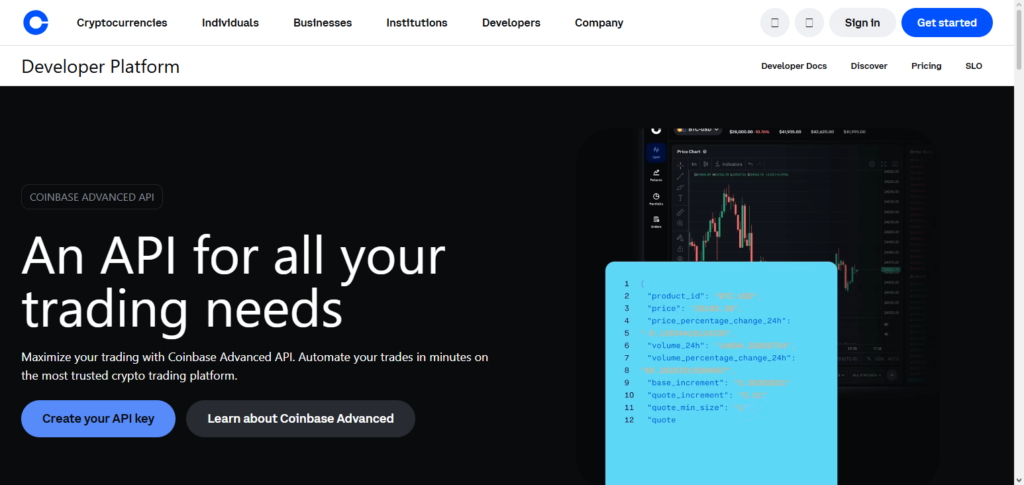
It offers solid documentation and real market feeds, streamlining the API for developers and perfect for algorithmic trading. One of the Best Crypto Trading APIs, the Coinbase Advanced Trade API is one of the most relied on APIs for compliance and ease of integration, and for users in regulated markets, its API is especially relied on.
| Feature | Details |
|---|---|
| Authentication | OAuth2 & API keys |
| Endpoints | REST & WebSocket |
| Trading | Spot, advanced order types (limit, stop, market) |
| Portfolio | Account balances, transaction history |
| Security | Institutional‑grade compliance, custody integration |
| Extras | Real‑time market feeds, strong documentation |
Coinbase Advanced Trade API Pros & Cons
Pros:
- Excellent regulation and compliance
- Supports advanced order types
- Easily integrates with Coinbase custody
- Market data in real-time
- Great dev documentation
Cons:
- Limited derivatives
- Higher fees vs some other exchanges
- Restricted in some jurisdictions
- API limits can be strict
- Primarily spot trading focus
2. Kraken API
The Kraken API provides REST and WebSocket tools for spot, margin, and futures trading. Kraken’s strong security offers encrypted authentication and withdrawal protection. This API also features staking and advanced margin and futures trading, making it versatile for retail and institutional traders alike.
As one of the Best Crypto Trading APIs, Kraken’s transparent fee structure and regulatory compliance make the API especially versatile and favored by developers who also prioritize safety, liquidity, and access to a wide range of crypto instruments including fiat pairs and derivatives.
| Feature | Details |
|---|---|
| Authentication | API keys with encrypted signing |
| Endpoints | REST & WebSocket |
| Trading | Spot, margin, futures, staking |
| Market Data | Real‑time order books, OHLC |
| Security | Strong reputation, withdrawal protection |
| Extras | Fiat pairs, transparent fee structure |
Kraken API Pros & Cons
Pros:
- Good security
- Spot, margin, and futures trading supported
- Fiat pairs available
- Clear fees
- Staking available via the API
Cons:
- More complex authentication
- Less coins available vs KuCoin
- Higher latency vs other APIs
- Less intuitive Futures API for beginners
- Some jurisdictions are restricted
3. Gemini API
The Gemini API provides REST and WebSocket endpoints and a sandbox to test strategies. It offers trading and custody with advanced compliance and regulations. Gemini also focuses on security and transparency. Multi-sig wallets and insurance are other features.
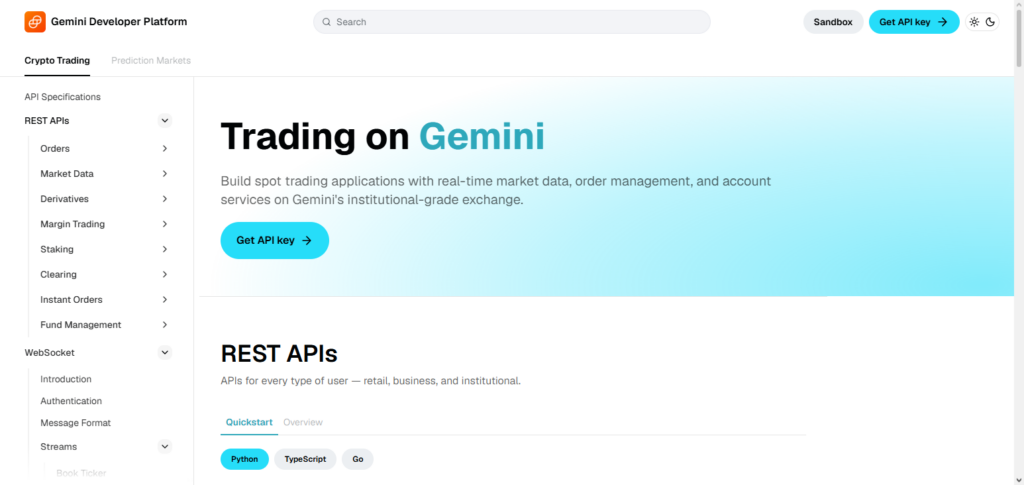
Developers get low latency access to real-time market data and trade execution. As one of the Best Crypto Trading APIs, Gemini API is appealing among traders wanting a regulated US exchange that has strong governance and is developer friendly.
| Feature | Details |
|---|---|
| Authentication | API keys with secure signing |
| Endpoints | REST & WebSocket |
| Trading | Spot trading, custody integration |
| Sandbox | Testing environment for developers |
| Security | Regulated US exchange, insured custody |
| Extras | Transparency, developer‑friendly tools |
Gemini API Pros & Cons
Pros:
- Regulated US exchange
- Testing environment available
- Custody and insurance integrated
- Clear governance and compliance
- Good dev tools
Cons:
- Limited derivatives
- Fewer coins and higher fees vs other global options
- Stricter API limits
- Less liquidity vs OKX and Bybit
4. OKX API
Advanced trading features like grid bots and copy trading are available among other features like REST and WebSocket access to high liquidity futures, options and perpetual swaps via the OKX API. Institutional grade risk management and excellent developer documentation are provided by OKX, which is favored by algorithmic traders for its solid product offerings and excellent infrastructure.
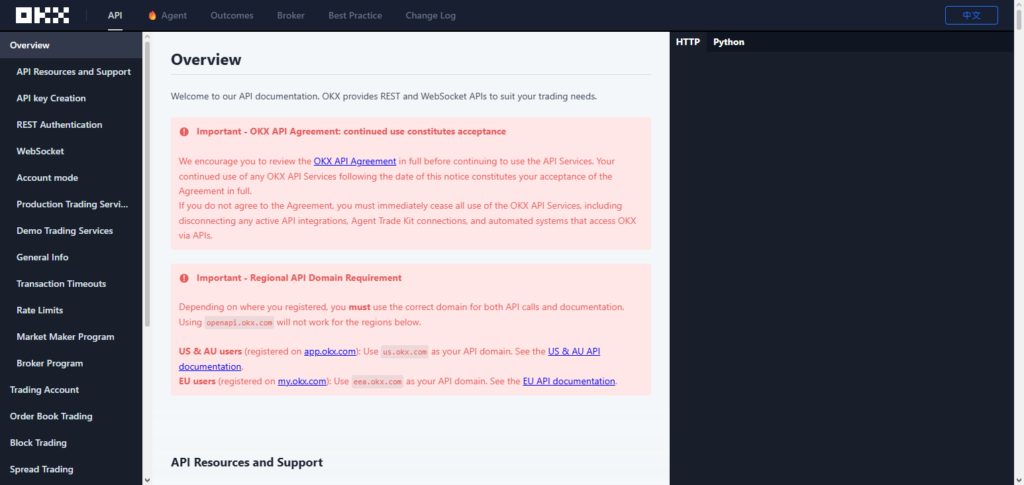
As one of the Best Crypto Trading APIs, the breadth of instruments combined with the OKX API’s excellent performance in high trading volume environments truly sets it apart.
| Feature | Details |
|---|---|
| Authentication | API keys & signatures |
| Endpoints | REST & WebSocket |
| Trading | Spot, futures, options, perpetual swaps |
| Market Data | High liquidity feeds |
| Security | Institutional‑grade risk management |
| Extras | Grid bots, copy trading |
OKX API Pros & Cons
Pros:
- Spot, futures, options and swaps supported
- High liquidity and advanced global trading
- Advanced trading bots and copy trading
- Strong institutional risk
- Comprehensive documentation
Cons:
- Complex API for traders and devs
- Derivatives have a higher learning curve
- Regulatory risk in some areas
- At times, there may be downtimes during high volatility periods
- High level of customization required for tech setup
5. Bybit API
The Bybit Derivates Trading API focuses on derivatives and has REST and WebSocket options for perpetual contracts, futures, and options. It has real-time market data and advanced order types, and it can be used for copy trading.
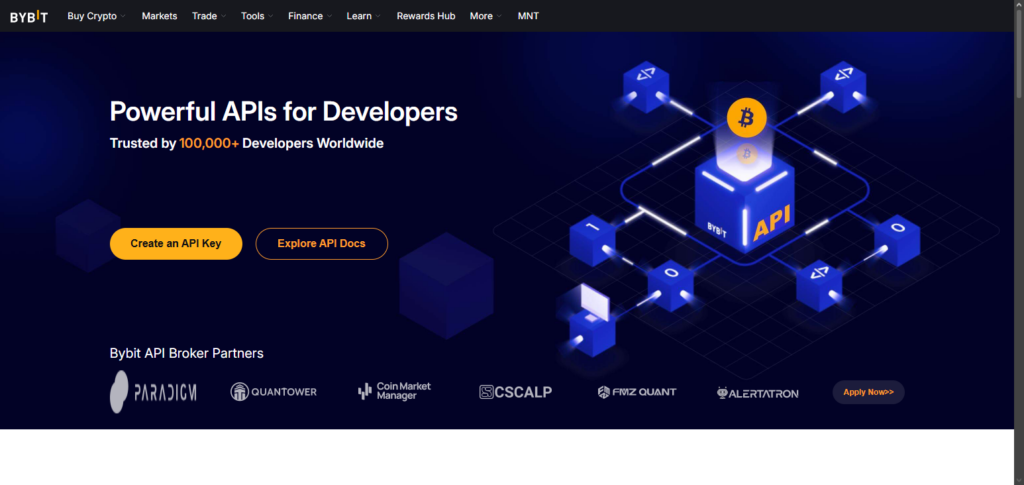
The API has a low-latency, high-throughput structure that is designed for professional traders. The API also has risk management tools and maintains a developer-friendly structure. Bybit APIs rank among the Best Crypto Trading APIs and are frequently used for derivatives trading and algorithmic trading in volatile markets.
| Feature | Details |
|---|---|
| Authentication | API keys & HMAC signing |
| Endpoints | REST & WebSocket |
| Trading | Perpetual contracts, futures, options |
| Market Data | Real‑time feeds, low latency |
| Security | Optimized infrastructure |
| Extras | Copy trading, derivatives focus |
Bybit API Pros & Cons
Pros:
- Derivative trading optimizations available
- Low latency system
- Supports perpetual contracts and futures
- Copy trading available
- Supports trading bots
Cons:
- Spot trading options are limited
- Derivatives trading may be heavily regulated in some jurisdictions
- Less fiat currency options compared to Kraken
- High trading limits may be dangerous for new users
- Less compliance oriented than Gemini
6. KuCoin API
KuCoin API offers developers access via REST and WebSockets to a vast array of markets. KuCoin is widely known for its access to a large variety of emerging crypto assets. Advanced order types, trading bots, and lending are available on the KuCoin API.
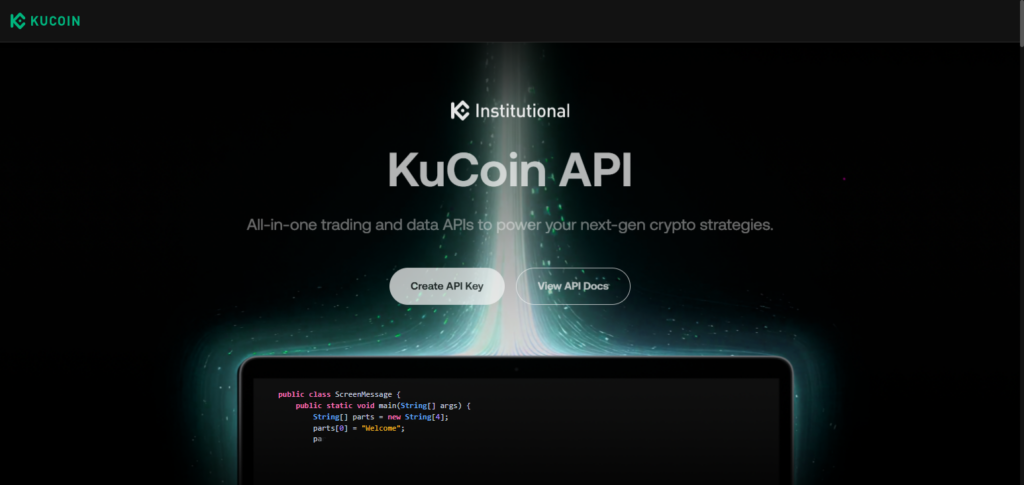
Developers gain from good documentation, and an active community. KuCoin APIs, one of the Best Crypto Trading APIs, is excellent for traders wanting a lot of different assets and a lot of different features with good infrastructure and reasonable costs.
| Feature | Details |
|---|---|
| Authentication | API keys & signatures |
| Endpoints | REST & WebSocket |
| Trading | Spot, margin, futures, lending |
| Market Data | Wide token listings |
| Security | Reliable infrastructure |
| Extras | Bot integration, community support |
KuCoin API Pros & Cons
Pros:
- Customizations and community support for trading bots is available
- Many tokens, even emerging ones, are available
- Lower fees are available
Cons:
- Less liquidity compared to Binance and OKX
- Past security breaches
- Compliance concerns in US/EU
- Complicated API for margin and futures trading
- May not support high frequency trading
7. FTX API (Legacy via partners)
After the collapse of the exchange, FTX API is still available via partner integrations for legacy data and trading features. FTX provided REST and WebSocket for Futures, Options and Leveraged Tokens. FTX was good for developer tools and provided a lot of data.

Although direct trading is not possible, a few partners provided data and features. Considering that FTX API was one of the Best Crypto Trading APIs for advanced trading derivatives before its shutdown, it is understood.
| Feature | Details |
|---|---|
| Authentication | API keys (legacy) |
| Endpoints | REST & WebSocket |
| Trading | Futures, options, leveraged tokens |
| Market Data | Historical data via partners |
| Security | Defunct post‑collapse |
| Extras | Innovative products (legacy only) |
FTX API (Legacy) Pros & Cons
Pros:
- Innovative product offerings (futures and leveraged tokens)
- Good legacy developer support / tools
- REST and WebSocket endpoints
- Historical data is available via former trading partners
- Used to be the go to for derivatives trading
Cons:
- Exchange Collapse – API down
- No support for live trading endpoints
- High security risk post Exchange Collapse
- Limited access via former trading partners
- Poor support for new integrations
8. Crypto.com Exchange API
The Crypto.com Exchange API features REST and WebSocket endpoints designed for use with spot and derivatives trading, as well as staking. It works with Crypto.com’s broader services, including wallets and payments.
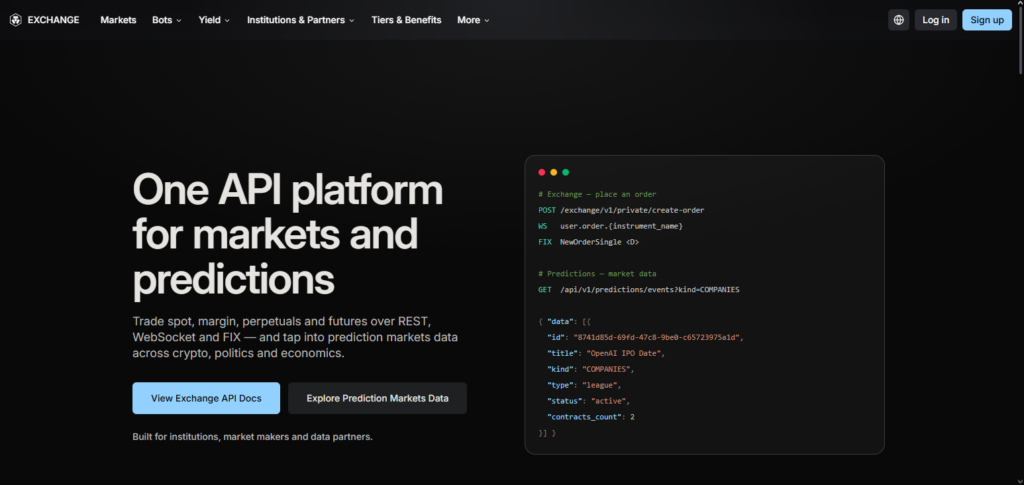
The API offers advanced trading, real-time market data, and enterprise-level security. Documentation and community support are good. Among the Best Crypto Trading APIs, Crypto.com Exchange API attracts traders needing integrated Crypto.com DeFi and retail payment services, and advanced features.
| Feature | Details |
|---|---|
| Authentication | API keys & secure signing |
| Endpoints | REST & WebSocket |
| Trading | Spot, derivatives, staking |
| Market Data | Real‑time feeds |
| Security | Institutional‑grade, linked to ecosystem |
| Extras | Wallet & payment integration |
Crypto.com Exchange API Pros & Cons
Pros:
- Integrated APIs for interoperability within Crypto.com Ecosystem
- Supports trading for derivatives, spot trading, and staking
- Market feeds with no latency and high security
- Wallet and payment integration
Cons:
- Onboarding developers is difficult and time consuming
- Higher fees than KuCoin and Bybit
- Less available tokens than KuCoin
- API rate limits may inhibit automation
- Geographical restrictions are present
9. Nomics API
Nomics API provides data for markets and offers clean and clear data for analysis. It focuses on transparent data. The API offers free and paid tiers.

Developers utilize Nomics for creating dashboards and trading bots as well as for building tools for research. Judging by its transparency and reliability in providing accurate market data for cryptocurrencies, Nomics API is one of the Best Crypto Trading APIs.
| Feature | Details |
|---|---|
| Authentication | API key |
| Endpoints | REST |
| Data | Market data, OHLCV, transparent volume |
| Coverage | Multiple exchanges normalized |
| Security | Rate‑limited free tier |
| Extras | Clean, normalized datasets |
Nomics API Pros & Cons
Pros:
- Market Data Transparency
- Historical OHLCV Account
- Normalized Datasets Available
- Free Tier
- Easy REST Integration
Cons:
- Rate Limits
- Data Only
- Premium Tier
- Governance and Fundamental Data Deficit
- Exchange Dependent
10. Messari API
Messari API provides advanced crypto data for institutions, offering base research, governance data, and insight samples. Their REST APIs expose detailed project representations and on-chain/market data. Messari’s data quality and depth fit a professional/analytical focus.
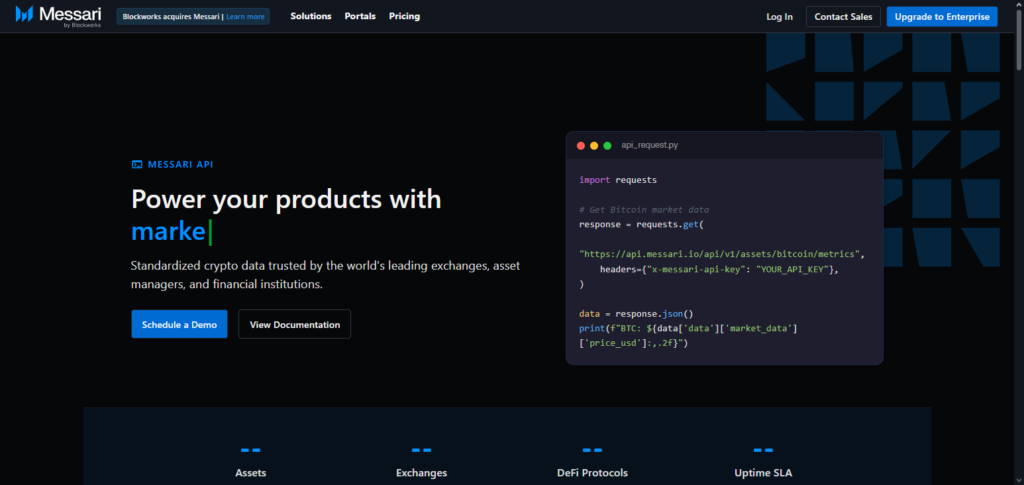
Developers also benefit from premium access tiers with more advanced datasets. Messari API is one of the Best Crypto Trading APIs and is considered a highly valuable research-centered service with broad coverage of crypto fundamentals.
| Feature | Details |
|---|---|
| Authentication | API key |
| Endpoints | REST |
| Data | Fundamental research, governance metrics |
| Coverage | Institutional‑grade insights |
| Security | Premium access tiers |
| Extras | Curated project profiles, on‑chain metrics |
Messari API Pros & Cons
Pros:
- Research Data
- Governance and Fundamentals
- Curated Project Research
- Premium Tiers
- Credibility in Research
Cons:
- No Trading Support
- Premium Required
- Limited Free Data
- Complex Data Sets
- Research Focus
| API | Strengths (Pros) | Weaknesses (Cons) |
|---|---|---|
| Coinbase Advanced Trade API | Strong compliance, advanced order types, custody integration, real‑time feeds, robust docs | Limited derivatives, higher fees, strict rate limits, restricted regions, spot‑focused |
| Kraken API | Strong security, supports spot/margin/futures, fiat pairs, transparent fees, staking | Complex auth, fewer tokens, higher latency, less intuitive futures, regional limits |
| Gemini API | Regulated US exchange, sandbox testing, custody with insurance, transparency, dev‑friendly | Limited derivatives, smaller token list, higher fees, rate limits, lower liquidity |
| OKX API | Spot/futures/options/swaps, high liquidity, bots & copy trading, institutional risk tools, detailed docs | Complex for beginners, regulatory uncertainty, steep learning curve, occasional downtime, technical setup needed |
| Bybit API | Derivatives focus, low latency, perpetual contracts, copy trading, developer‑friendly | Limited spot, regulatory restrictions, smaller fiat support, leverage risks, less compliance |
| KuCoin API | Wide token listings, spot/margin/futures/lending, strong community, bot integration, low fees | Past security issues, regulatory uncertainty, complex margin setup, lower liquidity, strict rate limits |
| FTX API (Legacy) | Innovative products (futures, leveraged tokens), strong dev tools, REST & WebSocket, historical data via partners, once popular | Defunct exchange, no active trading, security concerns, limited partner access, unsuitable for new projects |
| Crypto.com Exchange API | Ecosystem integration, spot/derivatives/staking, real‑time feeds, institutional security, wallet/payment links | Complex onboarding, higher fees, fewer tokens, strict rate limits, regional restrictions |
| Nomics API | Transparent market data, historical OHLCV, normalized datasets, free tier, easy REST integration | Free tier limits, no trading, premium needed for full access, limited governance data, exchange dependency |
| Messari API | Institutional research, governance metrics, curated profiles, premium tiers, strong credibility | No trading, subscription required, limited free tier, complex datasets, research‑only focus |
Conclusion
Crypto data and trading APIs offer a wide variety of options for traders, developers, and institutions. For users concerned with compliance, Coinbase Advanced Trade API, Kraken API, and Gemini API provide safe, regulated options.
For traders that are high volume and/or algorithmic, OKX API, Bybit API, and KuCoin API are excellent derivatives, futures, and comprehensive token API offerings. Crypto.com Exchange API integrates trading with the other services of the Crypto.com ecosystem.
For clarity in market data and institutional research, Nomics API and Messari API are both great offerings. Although FTX API is no longer in operation, it was once a pioneering API for derivatives trading. Each of these APIs has its own strengths in order to cover the broad spectrum of needs.
FAQ
What is a crypto trading API?
A crypto trading API (Application Programming Interface) allows developers and traders to connect directly to an exchange or data provider. It enables automated trading, portfolio management, and access to real‑time market data without using the exchange’s web interface.
Which are the best crypto trading APIs?
Some of the best APIs include Coinbase Advanced Trade API, Kraken API, Gemini API, OKX API, Bybit API, KuCoin API, Crypto.com Exchange API, and data providers like Nomics API and Messari API. FTX API is now legacy but was once widely used.
What makes Coinbase Advanced Trade API popular?
It offers advanced order types, strong compliance, and institutional‑grade security. It’s widely trusted in regulated markets and integrates seamlessly with Coinbase custody services.
Why do developers use Kraken API?
Kraken API is known for strong security, margin trading, futures, and staking support. It’s favored by developers who need reliable access to diverse instruments, including fiat pairs.