


In this article I will discuss the Best MPC Wallet Infrastructure Providers for Businesses. I will talk about their security, MPC models, supported blockchains, transaction controls, APIs, compliance support, pricing, wallet types and integration difficulty. This guide compares leading providers to help business identify the right MPC wallet infrastructure for secure, scalable, and efficient digital asset management and operations.
What Are MPC Wallet Infrastructure Providers?
MPC Wallet Infrastructure Providers are companies that offer the technology for businesses to build, secure, manage and operate cryptocurrency wallets with Multi-Party Computation (MPC). MPC distributes the key generation and signing responsibilities among multiple secure parties or environments instead of having one whole private key in one place.
The providers offer APIs, SDKs, transactions policies, control of access, wallet management, block-chain connectivity and monitoring tools. The infrastructure allows exchanges, fintech, Web3, payment providers and institutions to manage electronic assets, reducing private-key risks and making it easier to operate securely on the blockchain.
Why Businesses Are Choosing MPC Wallet Infrastructure
Better Transaction Control: Companies can set up approval workflows, spending limits, allowlists, and transaction policies prior to asset transfer.
Multi-User Authorization: MPC infrastructure can support multiple users, teams, or secure environments and can simplify the process of setting up organizational approval processes.
Multi-Chain Operations: Companies can run on multiple blockchains with a single wallet infrastructure rather than having to use multiple systems.
API-Driven Automation: Using APIs and SDKs, companies can automate wallet creation, transaction signing, transfers, balance monitoring and other blockchain operations.
Scalable Wallet Management: Companies can generate and manage a vast number of wallets without the burden of manually handling individual private keys.
Enterprise Governance: Role-based permissions, approval policies, audit logs, and administrative controls allow organizations to have more defined governance over digital resources.
Support for Institutional Operations Exchanges, fintechs, payment companies, funds and Web3 businesses are able to utilize the MPC infrastructure for treasury management, custody, settlements, payments and onchain transactions.
Reduced Operational Complexities: A specialized provider can provide wallet security, blockchain connectivity, transaction management and developer tools in one infrastructure layer.
Easier Business Expansion: The volumes of transactions, users, assets and blockchain networks are increasing, and MPC infrastructure can offer a more manageable basis for scaling digital-asset operations.
How We Selected the 10 MPC Wallet Providers
| Selection Criteria | What We Evaluated | Why It Matters for Businesses |
|---|---|---|
| MPC Security Model | MPC/TSS architecture, key-share management, signing approach, and security design | Helps businesses assess private-key and transaction-signing risks |
| Wallet Infrastructure | Embedded, institutional, custodial, self-custody, and programmable wallet options | Determines whether the provider fits the company’s operating model |
| Blockchain Support | Supported networks, tokens, EVM and non-EVM compatibility | Important for businesses operating across multiple blockchain ecosystems |
| Transaction Controls | Approval workflows, spending limits, allowlists, policies, and role permissions | Helps prevent unauthorized or high-risk transactions |
| API & SDK | APIs, SDKs, webhooks, documentation, and developer tools | Makes wallet integration and transaction automation easier |
| Compliance Support | Security certifications, audit capabilities, regulatory infrastructure, and compliance tools | Important for businesses with institutional or regulatory requirements |
| Recovery & Backup | Key recovery, backup mechanisms, account recovery, and business-continuity options | Reduces operational risks caused by lost access or unavailable users |
| Enterprise Features | Treasury management, reporting, user management, automation, and governance | Determines suitability for larger organizations |
| Scalability | Wallet capacity, transaction handling, automation, and multi-chain operations | Helps businesses scale without rebuilding their wallet infrastructure |
| Pricing | Subscription, usage-based, transaction, signature, or custom enterprise pricing | Helps companies estimate the overall infrastructure cost |
| Integration Difficulty | API complexity, SDK availability, documentation, and development requirements | Indicates how quickly a business can deploy the solution |
| Web3 & DeFi Support | dApp connectivity, smart-contract interactions, DeFi workflows, and onchain functionality | Useful for Web3 applications and businesses with advanced onchain needs |
| Business Use Cases | Exchanges, fintechs, payment companies, institutions, Web3 apps, and treasury teams | Ensures providers are evaluated according to real business requirements |
| Overall Business Fit | Combination of security, functionality, usability, cost, and scalability | Helps identify which provider is most appropriate for different business models |
Key Points
| Provider | Key Point |
|---|---|
| Fireblocks | Enterprise-grade MPC wallet infrastructure with policy controls, treasury management, embedded wallets, and support for 80+ blockchains. |
| BitGo | Combines MPC technology with institutional custody, trading, staking, and treasury solutions for businesses. |
| Copper | MPC-based custody and off-exchange settlement infrastructure widely used by trading firms and institutional investors. |
| Coinbase Prime | Institutional digital asset platform offering MPC-based custody, trading, and brokerage services for enterprises. |
| Anchorage Digital | Regulated institutional custody provider utilizing advanced digital asset security architecture and governance controls. |
| Fordefi | MPC self-custody wallet infrastructure designed for crypto funds, market makers, and DeFi-focused institutions. |
| Cobo | MPC/TSS wallet and custody platform supporting exchanges, Web3 companies, treasury operations, and payment businesses. |
| Utila | MPC-powered digital asset operations platform optimized for payments, stablecoin management, and fintech treasury workflows. |
| Dfns | API-first Wallet-as-a-Service platform providing MPC/TSS signing, embedded wallets, passkeys, and enterprise-grade controls. |
| Turnkey | Programmable wallet infrastructure offering secure key management, policy controls, embedded wallets, and developer APIs. |
1. Fireblocks
Fireblocks, founded in 2018, uses its MPC-CMP architecture with isolated key shares and hardware-backed security. It supports 200+ blockchain integrations like EVM, Bitcoin, Solana, TRON, Cosmos and other chains. The Policy Engine handles transaction approvals, destination controls, asset restrictions and spending rules.
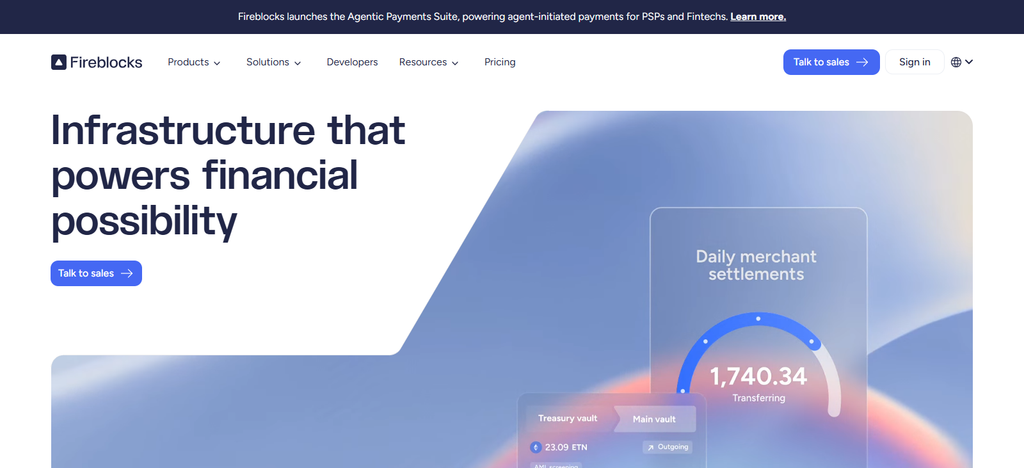
Fireblocks provides REST APIs and SDKs in TypeScript, Python, Java and other developer tools. Compliance capabilities include AML, Travel Rule & screening integrations. Pricing is generally enterprise focused, with paid plans and custom contracts. Integration difficulty is medium, and as such suitable for exchanges, fintechs, custodians, and institutional wallets.
| Characteristic | Details |
|---|---|
| Founded | 2018 |
| MPC Technology | TSS-MPC / MPC-CMP architecture |
| Wallet Type | Institutional, self-custody, custodial, embedded and Web3 wallets |
| Blockchain Support | 200+ blockchain networks and thousands of assets |
| Transaction Controls | Policy Engine, approval workflows, allow/block rules, spending limits and destination controls |
| API/SDK | REST APIs, SDKs and developer infrastructure |
| Security | MPC key shares, secure enclaves, policy enforcement and enterprise security controls |
| Compliance | Institutional compliance, audit reporting and multiple security certifications |
| DeFi Support | Yes, including integrations for DeFi and onchain applications |
| Enterprise Features | Treasury management, payments, custody, tokenization and transaction automation |
| Pricing | Enterprise/custom pricing; embedded-wallet plans can use usage-based or MAU-based models |
| Integration Difficulty | Moderate |
| Best For | Exchanges, fintechs, institutions, Web3 companies and payment businesses |
2. BitGo
Founded in 2013, BitGo offers institutional wallets with Threshold Signature Scheme (TSS) for MPC and multisignature technology. Its MPC structure has three key players, user, backup and BitGo, with transactions typically requiring a 2-of-3 signing process. Supported networks vary by asset and wallet type, including major account-based and UTXO assets.
BitGo provides APIs, developer tools and built-in blockchain infrastructure for submitting and monitoring transactions. Its wallet options are MPC hot, MPC cold, multisig hot, and multisig cold wallets. Pricing is generally customized for institutional clients, so integration difficulty is moderate to complex.
| Characteristic | Details |
|---|---|
| Founded | 2013 |
| MPC Technology | TSS-based MPC |
| Wallet Type | MPC Hot, MPC Cold, Multisig Hot and Multisig Cold |
| Blockchain Support | Broad institutional digital-asset coverage; support varies by asset |
| Transaction Controls | Multi-party signing, wallet policies and transaction authorization |
| Key Structure | 2-of-3 signing using user, backup and BitGo components |
| API/SDK | Developer APIs and blockchain infrastructure |
| Security | MPC/TSS, multisignature options and optional external signer |
| Custody | Qualified custody and self-custody options |
| Compliance | Institutional custody and regulatory infrastructure |
| Recovery | Backup-key and recovery mechanisms |
| Pricing | Primarily enterprise/custom |
| Integration Difficulty | Moderate |
| Best For | Exchanges, institutional custody, funds and businesses requiring custody flexibility |
3. Copper
Founded in 2018, Copper launched with MPC-based institutional custody and has a strong focus on custody, settlement and digital asset market infrastructure. Its MPC wallet architecture is built for institutional asset protection and operational control.
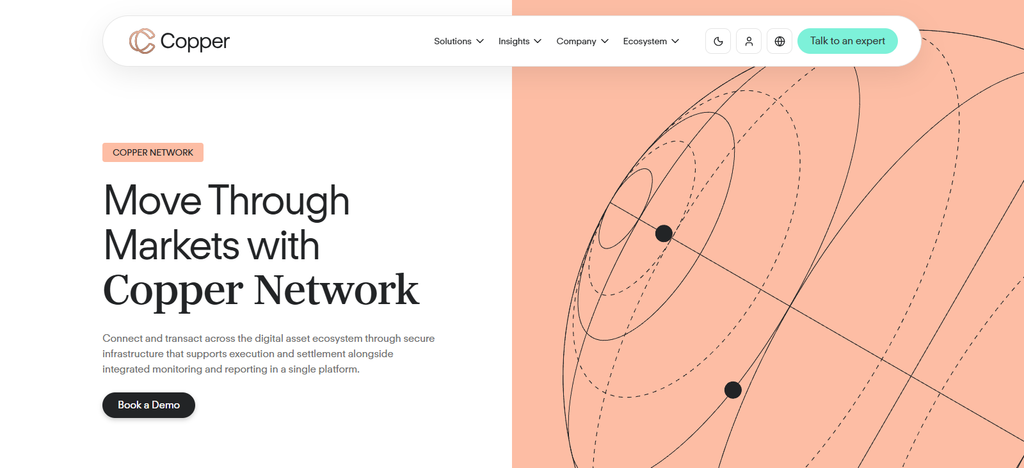
Supported networks and assets encompass major digital asset markets and availability depends on the particular Copper product and custody arrangement. Transaction workflows are driven by institutional authorization and settlement requirements.
Copper creates the infrastructure and API connectivity for businesses that are integrating custody and settlement operations. Compliance support includes SOC 2 Type 2 and ISO 27001 compliance. Pricing is mainly enterprise/custom and integration difficulty is moderate to high.
| Characteristic | Details |
|---|---|
| Founded | 2018 |
| MPC Technology | 2-of-3 MPC architecture |
| Wallet Type | Institutional custody and self-custody wallets |
| Blockchain Support | 60+ blockchain networks across its broader infrastructure |
| Transaction Controls | Institutional authorization, custody controls and settlement workflows |
| API/SDK | APIs and institutional integration infrastructure |
| Security | MPC-based key management and institutional custody controls |
| Compliance | Institutional compliance and security controls |
| Settlement | ClearLoop off-exchange settlement |
| DeFi | Supported through institutional infrastructure |
| Treasury | Custody, settlement and asset-management workflows |
| Pricing | Enterprise/custom |
| Integration Difficulty | Moderate to Advanced |
| Best For | Institutions, funds, trading firms and digital-asset businesses |
4. Coinbase Prime.
Coinbase Prime is a mix of institutional custody and trading infrastructure with a MPC-powered non-custodial Onchain Wallet. The current Prime Onchain Wallet supports Solana and EVM networks including Ethereum, Arbitrum, Base, Avalanche-C-chain, BNB Chain, Polygon, Optimism and Gnosis.
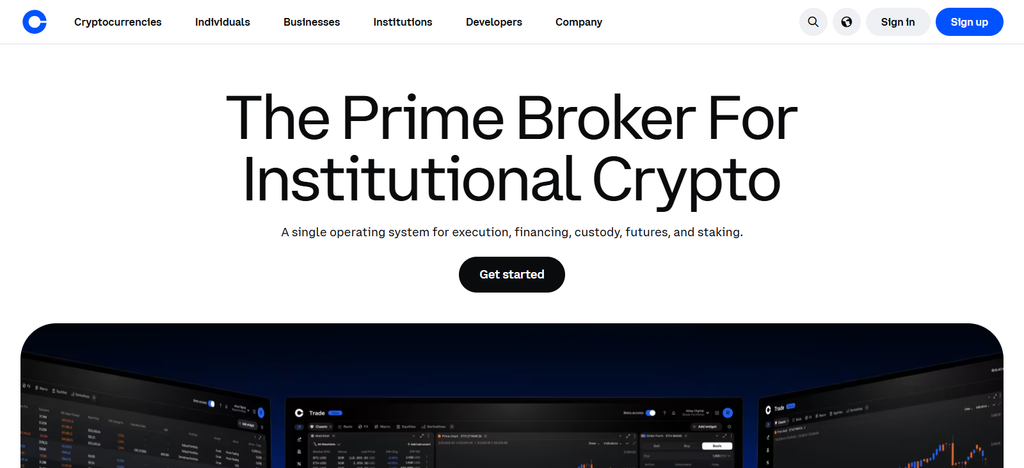
Prime’s institutional environment comes with native transaction controls, while still allowing users to interact with DeFi applications and smart contract functionality. Prime API access is available for workflows and institutions through Coinbase.
Compliance is provided through Coinbase’s regulated institutional infrastructure. Pricing is enterprise focused and per account. Integration effort is moderate. There are trading, custody, and MPC-based onchain wallet types.
| Characteristic | Details |
|---|---|
| Founded | Coinbase launched in 2012 |
| MPC Technology | MPC-based non-custodial Onchain Wallet |
| Wallet Type | Institutional custody, trading and non-custodial onchain wallet |
| Blockchain Support | Solana plus supported EVM-compatible networks |
| EVM Networks | Ethereum, Base, Arbitrum, Avalanche C-Chain, BNB Chain, Polygon, Optimism, Gnosis and others |
| Transaction Controls | Institutional Prime controls and wallet-management workflows |
| API/SDK | Coinbase Prime APIs and institutional developer infrastructure |
| DeFi | Direct dApp, DEX, staking, lending and smart-contract interaction |
| Custody | Qualified institutional custody plus non-custodial wallet |
| Compliance | Coinbase institutional regulatory and compliance infrastructure |
| Pricing | Account/product dependent |
| Integration Difficulty | Moderate |
| Best For | Institutions, funds, trading firms and businesses already using Coinbase Prime |
5. Anchorage Digital
Anchorage Digital was founded in 2017 and provides institutional custody infrastructure and self-custody through its Porto wallet. It features a self-custody architecture with institutional-grade controls, programmable signing policies and resilient recovery over traditional seed phrases.
Supported networks include Bitcoin, Ethereum, Solana, Sui, Arbitrum, Avalanche, Base, BNB Chain, Cosmos, Tron and more depending on the wallet and asset. Transaction controls include allow-lists, quorum approvals and daily limits.
REST APIs provide wallet, transfer, balance and trading automation. Compliance is very concerned with regulated institutional operations. Pricing varies by product, with Porto starting at $750/month.
| Characteristic | Details |
|---|---|
| Founded | 2017 |
| MPC Technology | MPC available alongside HSM-based security architecture |
| Wallet Type | Institutional custody and Porto self-custody wallet |
| Blockchain Support | ERC-20, SPL and selected non-EVM networks for Porto |
| Transaction Controls | Programmable signing policies, allowlists and quorum approval |
| Security | Hardware-backed security, device controls and cryptographic authentication |
| API/SDK | APIs and institutional integration tools |
| Recovery | Institutional recovery without traditional seed-phrase dependency |
| Smart Contracts | Transaction simulation and onchain interaction |
| Compliance | Strong institutional and regulated custody focus |
| Custody Model | Qualified institutional custody and self-custody options |
| Pricing | Product-dependent; enterprise pricing varies |
| Integration Difficulty | Moderate |
| Best For | Institutions, funds, treasury teams and regulated digital-asset businesses |
6. Fordefi
Fordefi, established in 2021, is an institutional MPC wallet and Web3 security platform designed for DeFi and on-chain operations. It uses self-custodial MPC for wallet infrastructure, with transaction simulation, smart-contract verification and a policy engine layered on top.
Fordefi supports ~70 blockchains including Ethereum, Arbitrum, Base, Solana, Cosmos, Bitcoin, Sui, Aptos, TON and Starknet, with custom EVM-chain support. Its Wallet API takes care of wallet creation, transactions, assets and notifications. Fordefi is SOC 2 Type II certified.
Pricing is mostly custom/enterprise and integration difficulty is moderate, especially for teams that require advanced DeFi workflows.
| Characteristic | Details |
|---|---|
| Founded | 2021 |
| MPC Technology | MPC-based institutional wallet security |
| Wallet Type | Institutional self-custody and Web3 wallet |
| Blockchain Support | Broad EVM and non-EVM coverage |
| Transaction Controls | Policy engine, transaction simulation and approval rules |
| Smart-Contract Security | Transaction simulation and contract-level controls |
| API/SDK | Wallet APIs and developer integrations |
| DeFi Support | Strong focus on DeFi and Web3 applications |
| Security | MPC, transaction simulation and policy-based governance |
| Compliance | Enterprise security and compliance controls |
| Automation | Programmable wallet and transaction workflows |
| Pricing | Enterprise/custom |
| Integration Difficulty | Moderate |
| Best For | Institutions, DeFi teams, trading firms and Web3 businesses |
7. Cobo
Founded in 2017, Cobo offers MPC Wallet-as-a-Service, custodial and smart-contract wallet infrastructure. Its MPC offering supports the send/receive wallets and Web3 wallets, with support for over 80 blockchains and 3,000+ tokens across its platform.
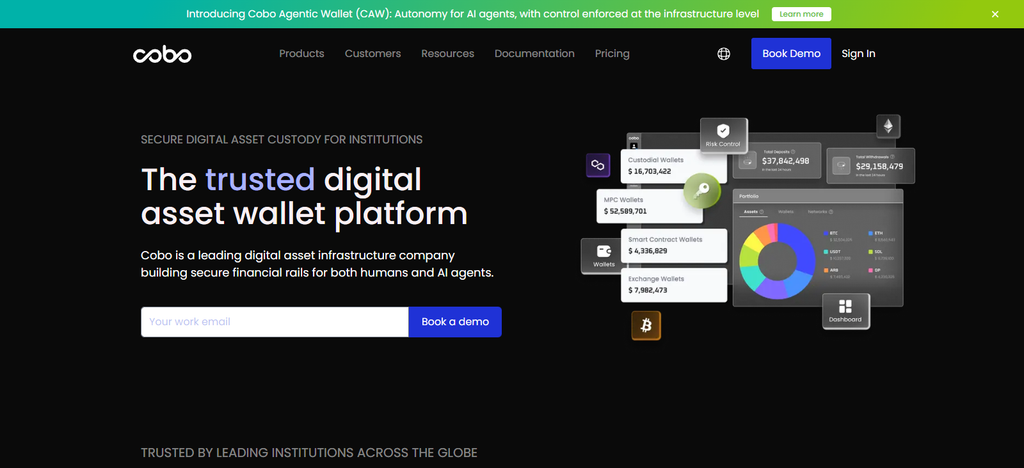
Businesses can create spender and withdrawal roles, risk policies and API keys for automated operations. Cobo provide APIs, SDKs, webhooks, developer sandbox tools and several programming languages including Python, JavaScript, Go and Java. Pricing is pretty transparent: Starter starts at $299/mo, Standard at $999/mo and Enterprise is custom. Moderate integration complexity, particularly for multi-chain businesses.
| Characteristic | Details |
|---|---|
| Founded | 2017 |
| MPC Technology | MPC wallet infrastructure |
| Wallet Type | Organization-Controlled and User-Controlled MPC wallets |
| Blockchain Support | Broad multi-chain coverage; availability varies by product |
| Transaction Controls | Organizational permissions, wallet controls and operational policies |
| API/SDK | APIs, SDKs, webhooks and developer tools |
| Smart Wallets | Supports smart-contract and account-abstraction wallets |
| Exchange Support | Exchange wallet management |
| Custody | Custodial and self-controlled wallet options |
| DeFi/Web3 | Supported through wallet infrastructure |
| Enterprise Features | Wallet management, transaction operations and institutional controls |
| Pricing | Product/plan dependent |
| Integration Difficulty | Moderate |
| Best For | Exchanges, Web3 companies, institutions and wallet platforms |
8. Utila
Utila is an institutional wallet infrastructure provider built on MPC-based security, policy-driven governance and multi-chain digital-asset operations. Its platform supports major EVM and non-EVM blockchains with APIs and webhooks to automate wallet creation, transactions, and operational workflows.
User-management transaction controls include approvals, limits, whitelists and policies. Utila also links wallets to exchanges, DeFi, compliance and security services. Its Starter plan is now $799 a month, with up to 1,000 active wallets, one vault, three users and up to $3 million in quarterly outbound volume; enterprise plans are customized. Integration difficulty is low to moderate for institutional teams.
| Characteristic | Details |
|---|---|
| Founded | 2021 |
| MPC Technology | 2-of-2 MPC architecture |
| Wallet Type | Institutional treasury and operational wallets |
| Blockchain Support | EVM and non-EVM networks |
| Transaction Controls | Policy engine, approval rules, spending limits and allowlists |
| Governance | Role-based access and administrator controls |
| API/SDK | APIs, webhooks and developer integrations |
| Treasury Features | Multi-wallet management and automated treasury workflows |
| Security | MPC plus secure signing infrastructure |
| Compliance | Audit logs and operational compliance controls |
| Pricing | Subscription and enterprise plans |
| Integration Difficulty | Low to Moderate |
| Best For | Crypto-native companies, treasury teams, funds and operational wallets |
9. Dfns
Dfns is a developer-centric wallet infrastructure platform that leverages MPC based key management and programmable wallet APIs. Its architecture is geared toward applications to create and manage wallets programmatically and without the traditional private-key handling.
The number of supported blockchains varies by plan, with Enterprise offering access to all supported blockchains. Dfns provides APIs, SDKs, web dashboards, webhooks and policies to perform wallet operations.
Pricing is subscription based, not AUM or transaction volume fees: Starter is $800/year Basic $8,000/year Pro $35,000/year and Enterprise is custom. Integration difficulty is low to moderate for teams that are comfortable with APIs.
| Characteristic | Details |
|---|---|
| Founded | 2020 |
| MPC Technology | TSS-MPC |
| Wallet Type | Programmable wallet infrastructure and embedded wallets |
| Blockchain Support | Multi-chain; coverage varies by plan and supported network |
| Transaction Controls | Policy-based wallet operations and permissions |
| API/SDK | APIs, SDKs and webhooks |
| Developer Focus | Strong developer-first infrastructure |
| Automation | Programmatic wallet creation and transaction management |
| Security | MPC-based key management |
| Compliance | Enterprise security and compliance capabilities |
| Infrastructure | Wallet-as-a-Service |
| Pricing | Subscription/enterprise pricing |
| Integration Difficulty | Low to Moderate for API-focused teams |
| Best For | Fintechs, Web3 applications, developers and businesses building custom wallets |
10. Turnkey
Turnkey is a developer-first wallet infrastructure platform with a focus on programmable key management, wallet creation and onchain transaction execution. Its infrastructure is built on secure signing technology and offers API-driven wallet and transaction management with EVM and SVM support for transaction workflows. Automate transaction construction, nonce management, signing, broadcasting and status tracking through a single API.
Policies, passkeys, OAuth, email authentication, and API keys enable operational controls. Pricing starts with a free-to-start Pay-As-You-Go plan at $0.10 per signature. Pro is $99/month and Enterprise has custom volume pricing. Developer integration difficulty is generally low to moderate.
| Characteristic | Details |
|---|---|
| Founded | 2022 |
| MPC Technology | Secure key-management and signing infrastructure |
| Wallet Type | Embedded and programmable wallets |
| Blockchain Support | EVM and SVM-focused wallet infrastructure, with additional signing capabilities |
| Transaction Controls | Programmable policies and signing permissions |
| API/SDK | Developer APIs, SDKs and low-level wallet primitives |
| Authentication | Passkeys, OAuth and API-key based workflows |
| Automation | Programmatic wallet creation and transaction signing |
| Developer Experience | Strong API-first approach |
| Security | Secure hardware and isolated signing infrastructure |
| Pricing | Usage-based and subscription plans; enterprise pricing available |
| Integration Difficulty | Low to Moderate for experienced developers |
| Best For | Web3 applications, fintechs, developers and custom wallet products |
Comparison Table: 10 Best MPC Wallet Infrastructure Providers
| Provider | Founded | MPC Model | Wallet Type | Blockchain Support | Transaction Controls | API/SDK | Compliance | Pricing | Integration Difficulty | Best For |
|---|---|---|---|---|---|---|---|---|---|---|
| Fireblocks | 2018 | MPC-CMP / TSS-MPC | Institutional, custody, embedded, Web3 | 200+ networks | Policy Engine, approvals, limits, allowlists | REST API, SDKs | Enterprise compliance & security controls | Custom / enterprise | Moderate | Exchanges, fintechs, institutions |
| BitGo | 2013 | TSS-MPC | MPC hot/cold, multisig | Major digital assets; varies by asset | Multi-party authorization, wallet policies | APIs & developer tools | Institutional compliance | Custom | Moderate | Exchanges, funds, custody |
| Copper | 2018 | 2-of-3 MPC | Institutional custody | 60+ networks; varies by product | Authorization & settlement controls | APIs & integrations | Institutional security & compliance | Custom | Moderate–Advanced | Institutions, funds, trading firms |
| Coinbase Prime | 2012 | MPC-based | Custody, trading, onchain | Solana + supported EVM networks | Prime controls & wallet management | Prime APIs | Institutional compliance infrastructure | Account-dependent | Moderate | Institutions, funds, trading firms |
| Anchorage Digital | 2017 | MPC + hardware-backed security | Institutional custody, self-custody | Multiple major networks | Allowlists, quorum approvals, limits | APIs & integrations | Strong institutional/regulatory focus | Product-dependent | Moderate | Institutions, treasury teams |
| Fordefi | 2021 | MPC | Institutional Web3 wallet | EVM & non-EVM networks | Policy engine, simulations, approvals | Wallet API | Enterprise security controls | Custom | Moderate | DeFi, Web3, trading firms |
| Cobo | 2017 | MPC | Organization/User-controlled wallets | 80+ networks; product-dependent | Permissions, policies, operational controls | APIs, SDKs, webhooks | Enterprise security & compliance | Plan-dependent | Moderate | Exchanges, Web3, institutions |
| Utila | 2021 | 2-of-2 MPC | Institutional treasury wallets | EVM & non-EVM | Policies, limits, approvals, allowlists | APIs & webhooks | Audit & institutional controls | Subscription / custom | Low–Moderate | Treasury teams, funds |
| Dfns | 2020 | TSS-MPC | Programmable & embedded wallets | Multi-chain; plan-dependent | Policies, permissions | APIs, SDKs, webhooks | Enterprise security/compliance | Subscription / custom | Low–Moderate | Fintechs, Web3 developers |
| Turnkey | 2022 | Secure programmable signing infrastructure | Embedded & programmable wallets | EVM & SVM-focused | Programmable policies & permissions | APIs & SDKs | Enterprise security capabilities | Usage-based / subscription | Low–Moderate | Developers, Web3 apps, fintechs |
Conclusion
The choice of the right MPC wallet infrastructure provider depends on your business model, security needs, supported blockchains, transaction control requirements, compliance requirements, API capabilities and budget.
For institutional operations, Fireblocks and BitGo are strong options, while Fordefi and Utila are well-suited for businesses that are focused on secure Web3 activities. Cobo, Dfns and Turnkey provide developer-friendly infrastructure to build programmable wallets and automated workflows. Coinbase Prime and Anchorage Digital are well suited for institutional digital-asset operations,
Copper has a strong focus on custody and settlement. Businesses should thoroughly compare these factors and select the provider that best fits their operational and growth requirements.
FAQ
What is an MPC wallet infrastructure provider?
An MPC wallet infrastructure provider offers businesses technology to create, manage, and secure crypto wallets using Multi-Party Computation. Instead of relying on one complete private key, MPC distributes signing responsibility across multiple parties or secure components.
Why do businesses use MPC wallets?
Businesses use MPC wallets to improve private-key security, control transaction approvals, manage employee permissions, automate blockchain transactions, and operate digital assets across multiple networks without depending on a single private key.
Is MPC more secure than a traditional crypto wallet?
MPC can reduce the risks associated with storing a single complete private key. However, security depends on the provider’s MPC architecture, authentication, access controls, recovery procedures, infrastructure, and operational policies.
What features should businesses look for in an MPC wallet provider?
Important features include MPC security, blockchain support, transaction policies, role-based permissions, APIs and SDKs, recovery options, compliance capabilities, audit logs, scalability, and pricing transparency.
Do MPC wallet providers support multiple blockchains?
Yes. Many enterprise MPC providers support multiple blockchain networks, including EVM-compatible chains, Bitcoin, Solana, and other major networks. However, supported assets and features differ between providers.