


Here, I will describe which APIs are the best for Decentralized Finance. These APIs give developers, traders and investors the tools to analyse the data and use the analytics in real time and with no interruptions.
The APIs related to CoinGecko, Birdeye, Bitquery, DEX screener and several others are the APIs that facilitate decentralized finance developments.
What is DeFi APIs?
DeFi APIs (Decentralized Finance Application Programming Interfaces) are blockchain tools offered to developers for building apps and connecting to other services and platforms through financial protocols.
DeFi APIs allow developers to access financial services and resources that are decentralized. These resources include token prices, wallet balances, lending, borrowing, staking, trading, liquidity pools, and smart contract interactions.
Building on blockchain infrastructure can become challenging and time consuming. DeFi APIs simplify this process for developers and businesses use DeFi APIs to build diverse financial technology applications and services including crypto wallets, exchanges, and Web3 applications.
How To Choose DeFi APIs for Developers & Traders
Supported Blockchain Networks
Different blockchains may have different DeFi API services to pull from, for example Ethereum, Solana, Polygon, BNB Chain, Avalanche, etc. APIs with Multi-chain support might allow developers to build more versatile applications and might give traders access to multiple ecosystems.
API Data Accuracy and Reliability
Good quality DeFi APIs should provide reliable data in regards to token price, liquidity pools, transactions, and market data. The quality of the data is very important for DeFi trading and can affect the success of the DeFi application.
Available Features
APIs should have tools that are either useful for building an application or for doing market analysis. Some of these tools may include wallet tracking, DEX data, smart contract interaction, token analysis, yield farming, and transaction data.
API Speed and Performance
Real-time data is important for both traders and developers, so market data is expected to have a low latency. High performance APIs should guarantee high uptime and low response time.
Security Standards
DeFi has its own set of security risks from transaction data loss to sensitive financial information. DeFi APIs should have secure infrastructures and data self-blocking to lower even more security risks.
Documentation and Developer Support
Easy to understand documentation and self explaining code are a major plus when choosing an API. An API that requires no extra help for beginners may save time and money on a project.
Compare Pricing Plans
Look closely at free tiers and paid plans to select a cost-effective API. Trading firms should also look for a provider that can scale with increasing demand.
Assess Scalability
A quality DeFi API should perform as expected, even with a large number of users and data. Scalable APIs will fit most of the Web3 applications and professional trading platforms.
Look for Advanced Analytics Tools
For a robust API that supports a better trading strategy, look for tools that provide market insights, historical data, and liquidity analysis as well as whale and on-chain analytics.
Test API Compatibility
Before choosing a provider, check if the API comfortably integrates with your preferred programming languages, frameworks, wallets, and existing blockchain setup, as this will greatly reduce maintenance load and limits flexibility.
Best DeFi APIs List
- CoinGecko
- Birdeye
- Bitquery
- DEX Screener
- Lambda Finance
- CoinStats
- CryptoCompare
- Coinbase API
- Moralis
- Alchemy
10 Best DeFi APIs
1. CoinGecko
CoinGecko supplies one of the largest pools of cryptocurrency data APIs by providing live price data, historical charts, market cap data, and token metadata. Developers use it when they need to add real-time DeFi data to an app, wallet, or trading terminal.
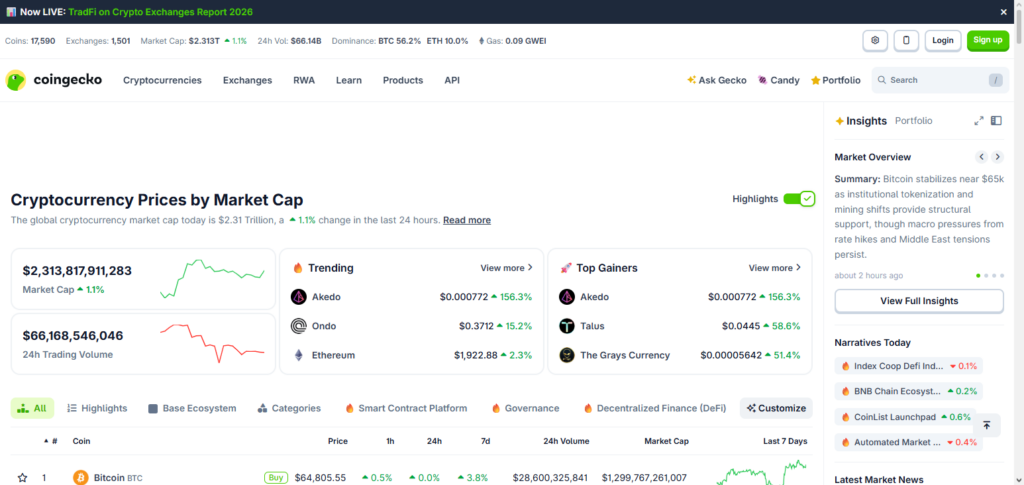
With thousands of tokens and exchanges, CoinGecko provides reliable data to DeFi projects. The CoinGecko API is well accepted because of its free tier and coverage, thus it is often used for DeFi data and portfolio tracking.
CoinGecko Trait
- Crypto price feeds in real time
- Charts with historical market data
- Token metadata and contract details
- Traders and exchanges pairs
- Wide API endpoints under free tier
| Benefits | Drawbacks |
|---|---|
| Free tier with wide coverage | Rate limits on free plan |
| Real‑time crypto price feeds | Limited advanced analytics |
| Historical charts and token data | No deep on‑chain data |
| Easy integration for developers | Premium plan needed for scale |
| Trusted by wallets & trackers | Data delays during high traffic |
2. Birdeye
Birdeye focuses on advanced on-chain data analytics, specializing in Solana and similar rapidly growing ecosystems. Their API includes trading data, swaps data, and liquidity pools.

Developers build tools like bots and dashboards using Birdeye. Monitoring speed on APIs and trading accuracy to give users an edge on DEXs is what makes Birdeye unique. As their user base grows, Birdeye will be used even more by projects wanting to understand the DeFi market better, liquidity, and how tokens are trading.
Birdeye Trait
- On-chain analyses for Solana and others
- Monitors liquidity pools
- Token swaps and trades
- Data in real time and of the best quality
- Bots and dashboards easy for developers to use
| Benefits | Drawbacks |
|---|---|
| Fast Solana ecosystem insights | Focused mainly on Solana |
| Real‑time liquidity pool data | Limited multi‑chain coverage |
| Token swap monitoring | Smaller developer community |
| Accurate trading analytics | Paid tiers for advanced queries |
| Useful for bots & dashboards | Less historical data depth |
3. Bitquery
Bitquery APIs support multiple chains with advanced blockchain data, covering Ethereum, BNB Chain, Polygon, etc. It also provides detailed transaction, smart contract, and DeFi protocol data. Bitquery is used to analyze DeFi token transfers, liquidity movements, and trading activities.
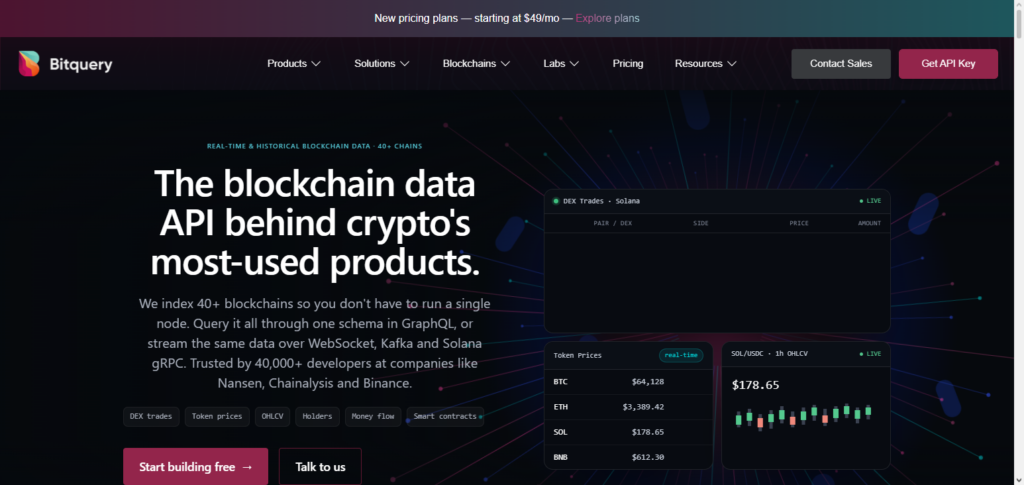
The Bitquery API is customizable to the extent that it allows for the submission of complex queries for research, compliance, and analytics. The ability of Bitquery APIs to supply DeFi and institutional users with detailed and organized blockchain data is what makes Bitquery APIs the go-to product.
Bitquery Trait
- Access blockchain data across all chains
- Queries for transactions and smart contracts
- Analytics for liquidity and DeFi protocols
- Queries can be custom structured
- Use cases for compliance and institutions
| Benefits | Drawbacks |
|---|---|
| Multi‑chain blockchain coverage | Complex query setup |
| Granular transaction data | Higher learning curve |
| Smart contract analytics | Premium pricing for scale |
| Customizable structured queries | Limited free tier |
| Institutional‑grade compliance tools | Slower for casual developers |
4. DEX Screener
Although DEX Screener is constantly improving, there are a few drawbacks. Many users still favor DEX Screener for its real-time decentralized exchange charts and token pair tracking. The API allows developers to integrate live price feeds and liquidity pool stats, along with trending tokens for users to use.
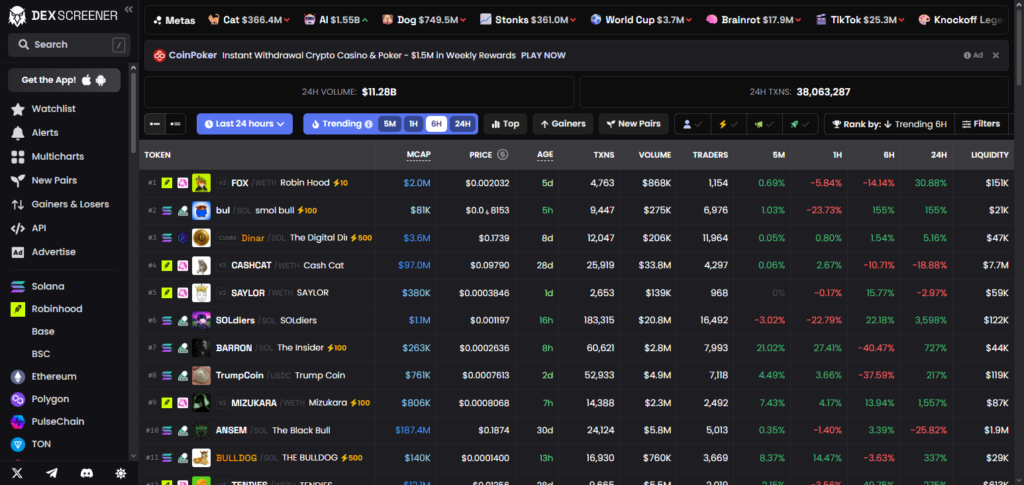
DEX Screener API is likely one of the most efficient APIs within the space if you need DeFi trading bots and analytics dashboards because of the instantaneous nature of its updates. The interface is user-friendly, and works with an innumerable amount of chains and token pairs.
DEX Screener Trait
- Token pairs and DEX charts in real time
- Analyses for liquidity pools and trends
- Support for many tokens across all chains
- APIs for user-created dashboards and trading bots
- Markets of DeFi accessible instantly
| Benefits | Drawbacks |
|---|---|
| Real‑time DEX charts | Focused on trading pairs only |
| Multi‑chain token coverage | Limited historical analytics |
| Liquidity pool stats | No deep compliance features |
| Easy bot integration | Free tier restrictions |
| Popular among DeFi traders | Not ideal for institutional use |
5. Lambda Finance
Lambda Finance combines decentralized finance, lending, and borrowing. They have APIs to assist developers with the management of interest rates, ratios, activities and lending pools. Developers can create risk management tools and dashboards that optimize yield.
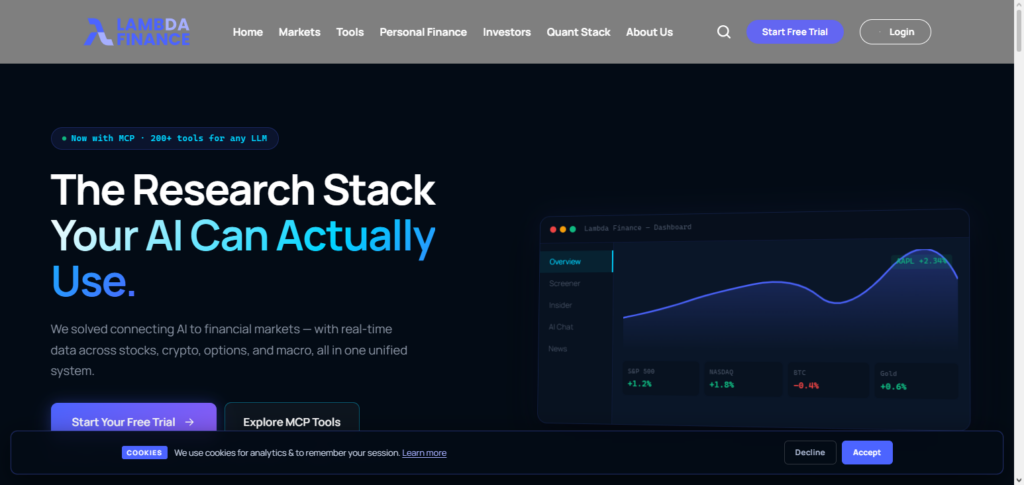
Their APIs provide a view and market comparison of decentralized lending networks, and offer users the ability to measure lending opportunities on different networks. Their metrics give insight into the DeFi lending spaces and assist users in achieving their maximum desired result and minimize their risks.
Lambda Finance Trait
- Data for lending and borrowing pools
- Track collateral and interest rates
- Insights for optimizing yields
- Measures risk mitigated
- All lending protocols of DeFi made clear
| Benefits | Drawbacks |
|---|---|
| Lending & borrowing insights | Niche focus on lending |
| Interest rate tracking | Limited token coverage |
| Collateral ratio monitoring | Smaller ecosystem adoption |
| Yield optimization tools | Less suited for traders |
| Transparency in lending pools | Paid features for advanced users |
6. CoinStats
CoinStats is a unique portfolio management tool with an API that aggregates both DeFi and CeFi information. This makes it possible for developers to create tools for viewing wallet balances, transaction histories, and token performance, no matter the blockchain.
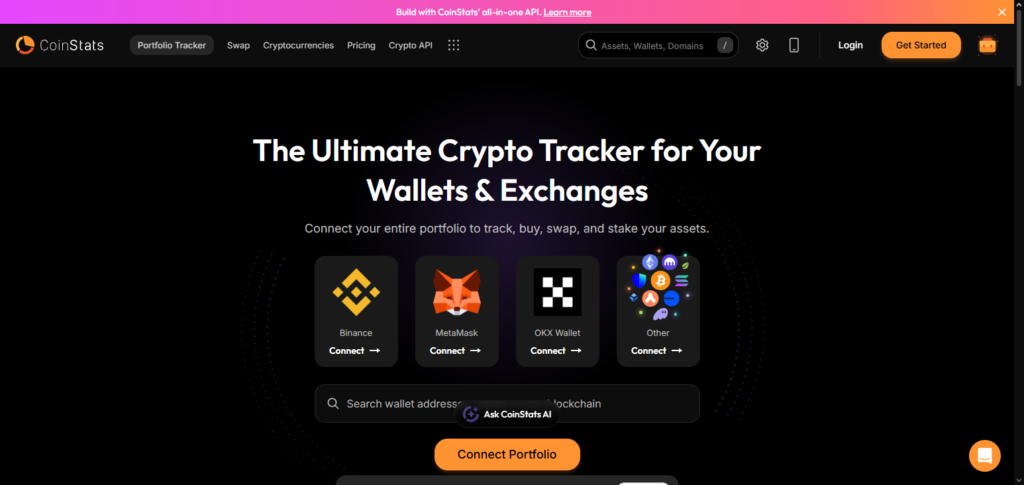
Because the CoinStats API has many integrations within popular DeFi protocols, it is very useful for developers to build portfolio trackers and investment dashboards, and it makes asset management very easy for users. CoinStats is easy to use, and has a clear user interface, so many retail investors and developers prefer using it.
CoinStats Trait
- Aggregate portfolios across blockchains
- Track wallet balances and transactions
- Track token performance
- Major DeFi protocols supported
- Portfolio management tools easy to use
| Benefits | Drawbacks |
|---|---|
| Portfolio aggregation | Limited free API calls |
| Wallet balance tracking | Focused on retail investors |
| Transaction history access | Not institutional‑grade |
| Token performance monitoring | Premium plan needed for scale |
| Integration with DeFi protocols | Less customizable queries |
7. CryptoCompare
CryptoCompare has high-quality data on the crypto market including DeFi tokens, trade prices, and metrics for exchanges, and even historical charts. Financial and research platforms use their API because of the detail and precision they exhibit.
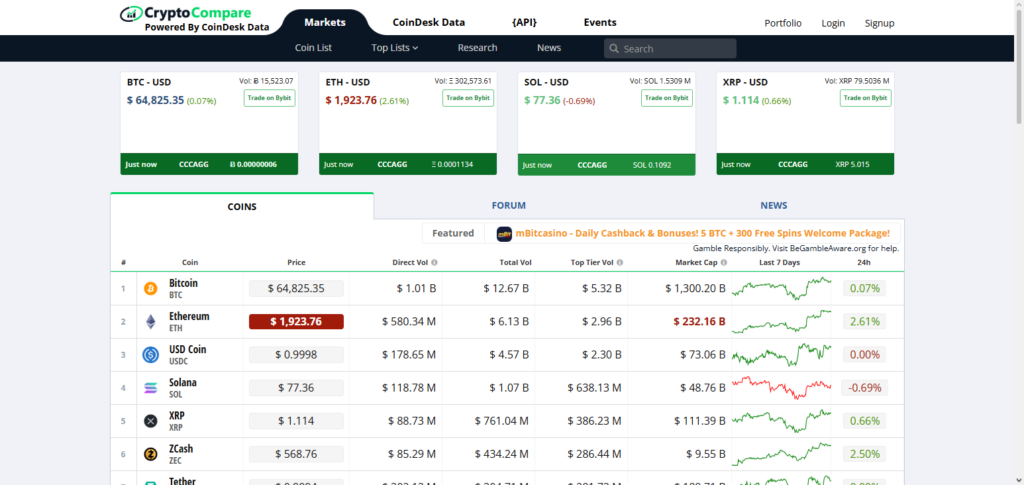
Their API encourages complex analytics and offers great support for risk modeling, strategies for trading, and compliance documentation. Covering thousands of different assets, developers and investors can be sure they are getting the best DeFi quality data for their decisions and management.
CryptoCompare Trait
- Data for crypto markets of all trusts
- Historical charts for tokens and queries
- Insights for exchanges and liquidity
- Support for trading and risk compliance
- Trustworthy data to support trade
| Benefits | Drawbacks |
|---|---|
| Institutional‑grade data | Higher pricing tiers |
| Reliable historical charts | Limited free tier |
| Exchange metrics & liquidity | Less focus on DeFi lending |
| Risk modeling support | Complex integration for beginners |
| Trusted by financial platforms | Requires subscription for full access |
8. Coinbase API
Coinbase provides a developer-friendly API to interact with trading, wallets, and crypto payments. While Coinbase is mostly a centralized service, DeFi integrations are offered through token info and the blockchain.
An API like Coinbase is a popular choice amongst developers who need a way to authenticate users with the support of secure and direct integration, offer fiat-to-crypto transactions, and check the price of DeFi tokens.
Coinbase is a preferred API amongst developers looking to build applications that incorporate a fusion of traditional and decentralized finance.
Coinbase API Trait
- Secure authentication and wallet access
- Fiat-to-crypto conversion endpoints
- Token data and blockchain connectivity
- Payment and trading integration
- Compliance-ready infrastructure for apps
| Benefits | Drawbacks |
|---|---|
| Secure authentication | Centralized focus |
| Fiat‑to‑crypto conversion | Limited DeFi analytics |
| Token data access | Restricted to Coinbase ecosystem |
| Payment integration | Not fully decentralized |
| Compliance‑ready infrastructure | Advanced features require approval |
9. Moralis
Moralis is a Web3 Dev platform that has APIs that make working Web3 Dev easier. It combines the features of DeFi, NFTs, and blockchain data. Moralis provides the endpoints necessary to make decentralized apps.
These can track wallet balances, token transfers, and smart contract events. Dapps created using Moralis are DeFi ready in a fraction of the time since Moralis is cloud powered and you don’t have to create backend services that can handle your dApp. It’s API is one of the most versatile for decentralized and financial services.
Moralis Trait
- Web3 development platform APIs
- Wallet Balances and Token Transfers
- Smart Contract Event Tracking
- Cross-Chain Support for dApps
- Scalable Infrastructure for DeFi Projects
| Benefits | Drawbacks |
|---|---|
| Web3 developer‑friendly | Requires coding expertise |
| Wallet & token endpoints | Paid tiers for scaling |
| Smart contract event tracking | Can be complex for beginners |
| Cross‑chain support | Limited free usage |
| Scalable infrastructure | Dependency on Moralis ecosystem |
10. Alchemy
Alchemy provides APIs for developers of DeFi applications on Polygon, Ethereum, and other chains, and integrates blockchain infrastructures.
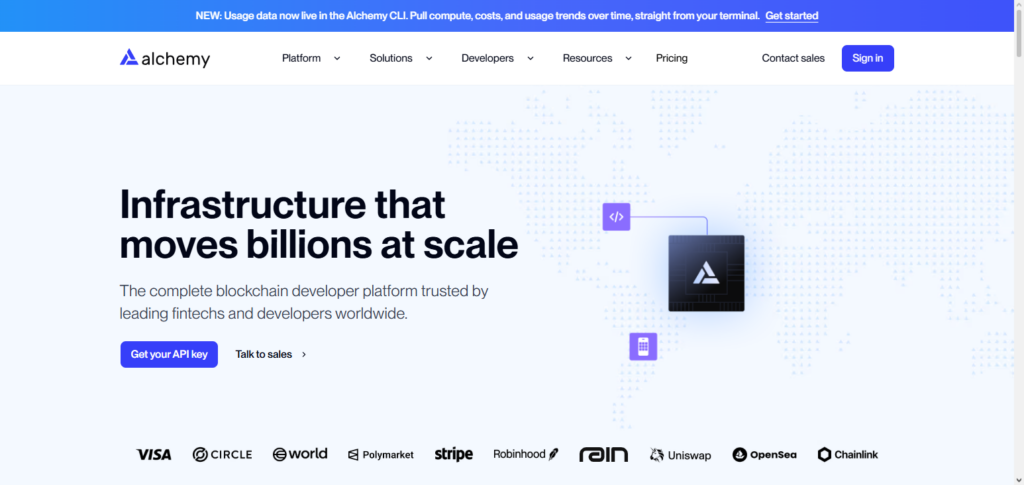
Its reliable node access, transaction analysis, and Smart Contract data are other helpful services provided by Alchemy’s API, and it is often utilized by DeFi projects for its scalability, uptime, and DevRel. Alchemy streamlines interaction with blockchain for developers, thus allowing them to create DeFi solutions, while Alchemy takes care of the backend functionalities.
Alchemy Trait
- Reliable Blockchain Node Access
- Transaction Monitoring and Analytics
- Smart Contract Data Endpoints
- Scalable Infrastructure with High Uptime
- Trusted by Top DeFi Projects Globally
| Benefits | Drawbacks |
|---|---|
| Reliable blockchain node access | Premium pricing for scale |
| Transaction monitoring | Limited free tier |
| Smart contract data | Focused on infrastructure, not analytics |
| High uptime & scalability | Requires technical expertise |
| Trusted by top DeFi projects | Less suited for casual users |
Conclusion
Selecting the correct API is key to creating reliable and scalable data-driven dApp in DeFi. Each of the noted DeFi APIs had their own specialties. CoinGecko and Birdeye provide market data; Bitquery and DEX Screener provide on-chain analytics, and Lambda Finance and CoinStats provide lending and portfolio data.
CryptoCompare and Coinbase API provide institutional-grade services with compliance data, while more simplistic and easy to use APIs like Moralis and Alchemy provide dApp infrastructure.
All these APIs provide data in a DeFi space and allow developers, traders, and investors access data in blockchain in real time.
The selective use of these APIs provides a solid and scalable dApp in DeFi while optimizing and securing the resources and services in the space. The correct APIs allows for improvement to a dApp in the space and can provide users with a better experience.
FAQ
What is a DeFi API?
A DeFi API is a set of endpoints that allows developers to access decentralized finance data such as token prices, liquidity pools, transactions, and smart contract activity.
Which DeFi API is best for price data?
CoinGecko and CryptoCompare are widely considered the best for accurate, real‑time price feeds and historical charts.
Which DeFi API is best for on‑chain analytics?
Bitquery and DEX Screener excel at providing detailed blockchain transaction data, liquidity pool stats, and token pair insights.
Are DeFi APIs free to use?
Most APIs like CoinGecko and Birdeye offer free tiers, while advanced features or higher request limits may require paid plans.
Which DeFi API is best for developers building dApps?
Moralis and Alchemy are developer‑focused, offering scalable infrastructure, cross‑chain support, and simplified smart contract integration.